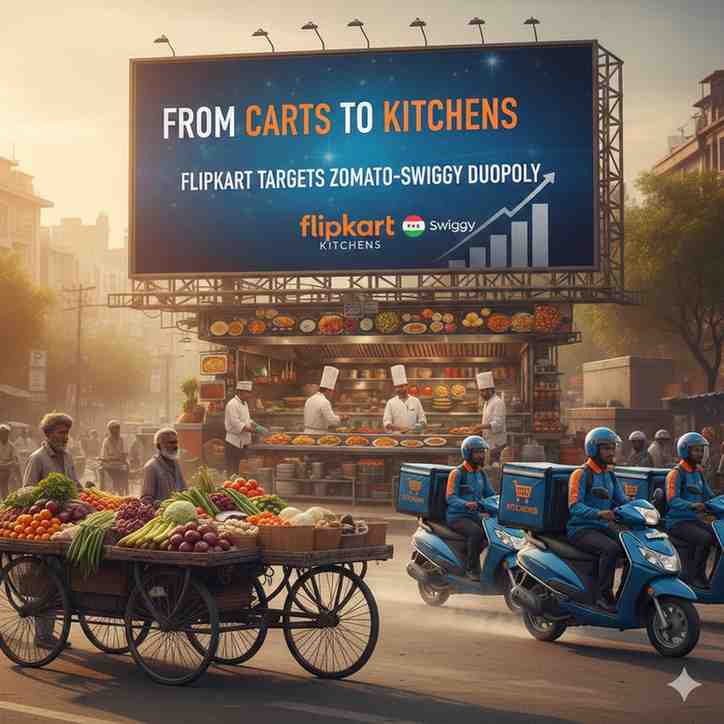
From Carts to Kitchens: Flipkart Targets Zomato-Swiggy Duopoly with 2025 Food Delivery Pivot
- Editor
- February 13, 2026
- Business, Companies & Industry, Foods
- 0 Comments
BENGALURU — The long-standing “peace treaty” between India’s e-commerce giants and food delivery titans has officially collapsed. Flipkart, the Walmart-owned e-commerce leader, has greenlit a strategic entry into the online food delivery market, preparing to challenge the entrenched duopoly of Zomato and Swiggy.
The move marks a significant escalation in India’s hyperlocal wars, as the boundaries between e-commerce, grocery, and food delivery continue to blur into a single “everything-app” race.
Tactical Execution: The Bengaluru Blueprint
Flipkart is not rushing into a nationwide battle. Instead, it is adopting a calculated, phased approach:
- The Pilot: A high-stakes pilot program is scheduled to launch in Bengaluru in May 2025 [1.1, 2.5]. This phase will test consumer appetite and operational efficiency in India’s tech capital.
- Full-Scale Expansion: Should the pilot succeed, Flipkart plans a broader nationwide rollout by late 2026 or early 2027 [1.2, 4.2].
- The Model Dilemma: The company is currently weighing two distinct strategies: launching a standalone food delivery app or operating as a buyer-side platform on the government-backed Open Network for Digital Commerce (ONDC) [2.1, 4.3]. Using ONDC would allow Flipkart to tap into an existing restaurant network without the heavy lifting of individual onboarding.+1
The Rivalry: A Defensive Counter-Offensive
Industry analysts view this as a direct retaliation. For years, Flipkart and Zomato stayed in their respective lanes. However, the rise of Quick Commerce changed the rules:
- Encroachment: Zomato (via Blinkit) and Swiggy (via Instamart) have aggressively entered the grocery, electronics, and home essentials space—territories once dominated by Flipkart.
- The Strike Back: By entering food delivery, Flipkart is hitting its rivals where it hurts most—their core, high-frequency business.
- The “Minutes” Advantage: Flipkart is not starting from zero. Its quick-commerce arm, Flipkart Minutes, already operates over 800 dark stores [3.1, 4.2]. This existing infrastructure of micro-warehouses and a massive last-mile delivery fleet provides the logistical “muscles” needed to deliver hot meals within 20–30 minutes [1.1].+2
Strategic Rationale: The IPO Narrative
The timing of this “Logistics War” is no coincidence. Flipkart is currently preparing for a public listing (IPO) in 2026 [1.5, 4.2].
- Ecosystem Depth: Investors value platforms that can capture a “daily share of wallet.” While e-commerce is often seasonal, food delivery is a high-habit, daily-use service that keeps users inside the app ecosystem.+1
- Market Potential: India’s food delivery market is projected to grow from $9 billion in FY25 to $25 billion by 2030 [1.2, 2.2]. For Flipkart to justify a premium valuation, it must prove it can capture a slice of this massive, recurring revenue stream.