ENERGY SHOCK 2026: BlackRock CEO Warns of $150 Oil Triggering Global Recession
- Editor
- March 27, 2026
- breaking news, Business, Companies & Industry, Energy & Environment
- 0 Comments
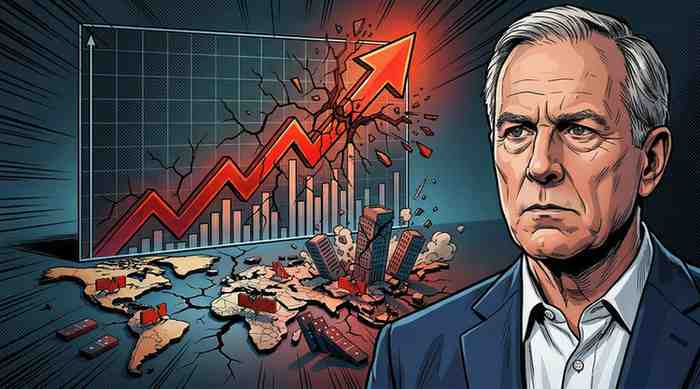
NEW YORK / LONDON — In a week defined by extreme market volatility and a deepening military crisis in the Middle East, BlackRock Chairman and CEO Larry Fink has delivered a sobering ultimatum to global markets: Prepare for a $150 oil-induced recession.
Speaking with the BBC as the conflict between the U.S., Israel, and Iran enters its second month, Fink characterized the current energy landscape as the most perilous since the 1970s.
Segment 1: The “Regressive Tax” on Growth
Fink’s primary thesis centers on the $150 price point for Brent crude—a level he believes would shatter global consumer spending and force central banks into an impossible corner.
- The Recession Trigger: Fink stated that sustained oil at $150 per barrel would “unquestionably” plunge the world into a “stark and steep” recession.
- The Regressive Tax: He warned that skyrocketing energy costs act as a punitive tax on the poor, disproportionately affecting lower-income households and emerging markets like India and Brazil.
- The Divergent Paths: Fink outlined two futures: A “Normalization” scenario where Iran is reintegrated and prices drop toward $70, or a “Stagnation” scenario where the Strait of Hormuz remains a perpetual threat, pinning prices between $100 and $150 for years.
Segment 2: Diplomacy in Deadlock – Trump vs. Tehran
The economic alarm bells are ringing louder following the collapse of a secret U.S. peace initiative. President Donald Trump’s 15-point ceasefire proposal, transmitted via Pakistani mediators, was officially rejected by Tehran on Wednesday.
| The U.S. “Grand Bargain” (15 Points) | Iran’s “Counter-Ultimatum” (5 Points) |
| Full lifting of economic sanctions. | Formal recognition of sovereignty over the Strait of Hormuz. |
| U.S. aid for civilian nuclear power. | Guaranteed war reparations and compensation. |
| Demand: Dismantle all nuclear sites. | Demand: Permanent halt to U.S./Israeli “assassinations.” |
| Demand: End support for regional proxies. | Demand: Region-wide ceasefire on all fronts (Lebanon, Iraq, Yemen). |
Iranian officials labeled the U.S. plan “detached from battlefield realities,” while the White House warned that refusal to negotiate would result in Iran being “hit harder than ever before.”
Segment 3: The Hormuz Chokehold
The International Energy Agency (IEA) has labeled the current maritime blockade the largest energy disruption in history.
- Supply Vacuum: With the Strait of Hormuz effectively closed, the market has lost approximately 20 million barrels per day—roughly 20% of global supply.
- Force Majeure: Major producers including Qatar, Kuwait, and the UAE have declared force majeure on contracts, unable to guarantee shipments as tankers face drone and missile strikes.
- Market Reaction: While prices briefly dipped to $98 on ceasefire rumors, they surged back above $104 following the rejection of the 15-point plan.
Segment 4: The Market Pivot – Tech Out, Defense In
Wall Street is aggressively re-positioning as the “peace dividend” evaporates.
- Equities Under Fire: High-growth tech stocks have trended downward as rising energy-driven yields make valuations harder to justify.
- The AI Anomaly: Despite the gloom, Fink noted that AI investment remains “acyclic,” with tech giants on track to spend $700 billion in 2026. However, private credit markets are showing “cracks” in loans tied to energy-sensitive software sectors.
- Defense Boom: Global defense spending is projected to hit $3 trillion by year-end, as nations pivot from “efficiency” to “security.”
The Bottom Line: Larry Fink’s warning suggests that while the global economy is less energy-intensive than in 1973, the sheer scale of the Hormuz closure—a 20% supply shock—leaves no room for error. The world is now in a race between a diplomatic breakthrough and a $150 price spike that could end the current growth cycle.