Elon Musk’s Net Worth Hits Historic $850B Following SpaceX and xAI Merger
- Editor
- February 14, 2026
- Business, Business Trends, Economy, Technology
- 0 Comments
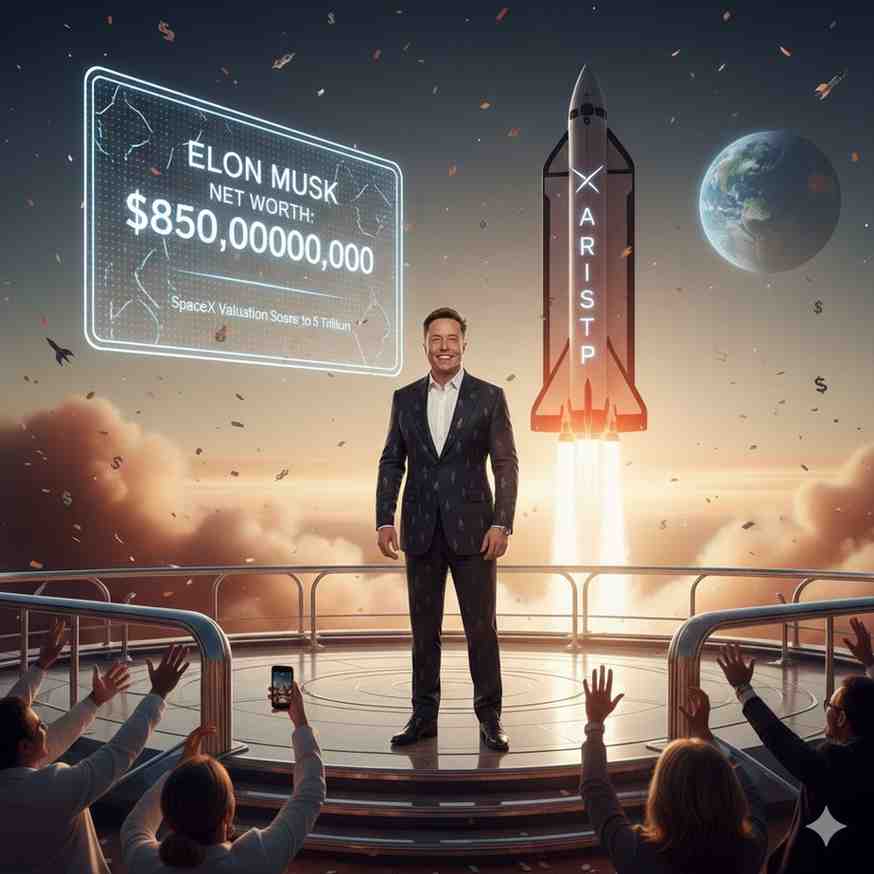
Boca Chica, Texas — February 2026 | In a move that has sent shockwaves through both Silicon Valley and the aerospace industry, Elon Musk has officially consolidated his empire. Following the high-stakes merger of SpaceX and xAI, Musk’s personal net worth has surged to an unprecedented $852 billion, moving him closer to becoming the world’s first trillionaire.
The merger creates a private entity unrivaled in scale, centered around a singular, futuristic goal: moving the world’s computational “brain” into Earth’s orbit.
The $850 Billion Math
The valuation spike stems from the synergy between Musk’s most successful hardware venture and his rapidly scaling AI arm. Analysts estimate Musk owns approximately 43% of the new combined entity, which is currently valued at a staggering $1.25 trillion.
To put this wealth into perspective, Musk is now nearly three times richer than Google co-founder Larry Page ($270 billion) and has surpassed the combined GDP of several mid-sized nations.
Orbiting Data Centers: The End of Earth-Bound Hosting
The strategic heart of this merger is the deployment of space-based data centers utilizing Starlink (STL) satellite technology. The logic is as much about physics as it is about finance:
- Natural Cooling: Data centers on Earth struggle with immense heat and water consumption; in the vacuum of space, heat management becomes an engineering challenge rather than an environmental one.
- Energy Efficiency: By mounting AI servers directly onto Starlink satellites, the “Mothership” entity can tap into near-constant solar energy without the limitations of a terrestrial power grid.
- The Price War: Within the next two to three years, the company aims to become the world’s cheapest provider of computing and hosting services, potentially undercutting giants like Amazon Web Services (AWS) and Microsoft Azure by leveraging SpaceX’s low-cost launch capabilities.
A Multi-Planetary Intelligence
By merging xAI—the creators of the Grok LLM—with the logistical power of SpaceX, Musk is effectively building a “vertically integrated” future. SpaceX provides the “body” (the rockets and satellites), while xAI provides the “mind.”
Insiders suggest this move was inevitable. Training next-generation AI requires massive amounts of data and power. By taking the process off-planet, Musk bypasses Earth’s regulatory hurdles regarding energy consumption and land use, creating a “sovereign” data cloud that exists 550km above the ground.
The Global Economic Shift
The implications for the broader tech market are profound. If Musk succeeds in providing ultra-cheap, space-based AI hosting:
- Traditional Clouds: AWS and Google Cloud may face a “race to the bottom” on pricing.
- Infrastructure: The demand for terrestrial data centers could peak and decline as orbital latency continues to improve.
- Monopoly Concerns: Regulators are already expressing concern that one individual now controls the world’s primary satellite internet, its most advanced heavy-lift rockets, and its most ambitiously hosted AI.
Bottom Line
The SpaceX-xAI merger is more than a financial consolidation; it is a declaration of intent. For years, Musk talked about making life multi-planetary. With an $850 billion war chest and an orbital AI network in development, he is no longer just building rockets to get to space—he is building the infrastructure to run the digital world from it.