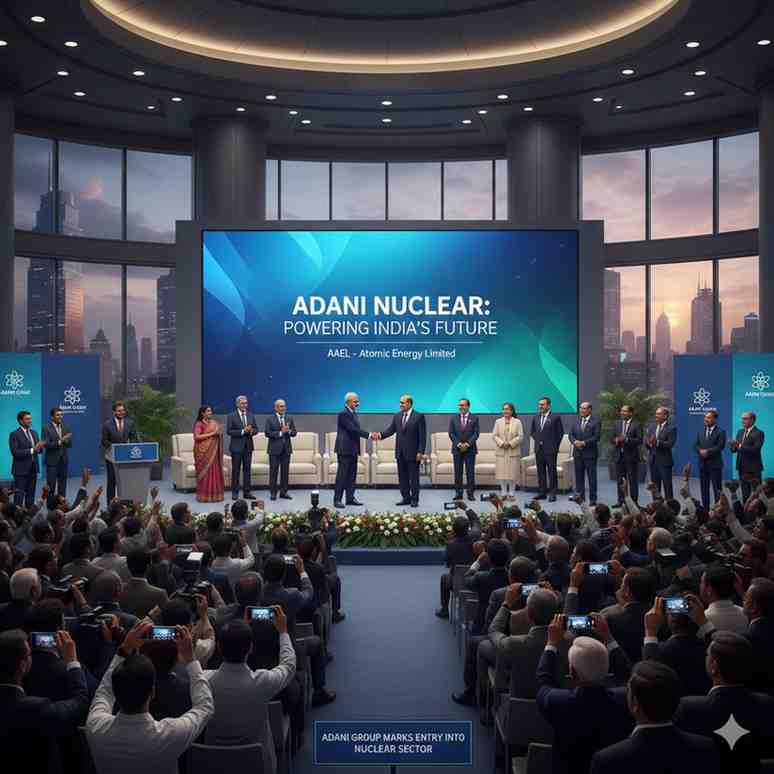
Atomic Ambition: Adani Group Marks Entry into Nuclear Sector with AAEL
- Editor
- February 13, 2026
- Business, Business Trends, Companies & Industry, Development, Economy
- business posts, trending posts
- 0 Comments
MUMBAI — In a move that signals a historic shift in India’s energy landscape, the Adani Group has formally entered the nuclear power sector. The conglomerate’s flagship utility, Adani Power Limited (APL), announced the incorporation of Adani Atomic Energy Limited (AAEL) on February 11, 2026, positioning itself as a first-mover in a domain previously reserved exclusively for the state.
The formation of this wholly-owned subsidiary comes just months after the Indian Parliament passed the transformative Sustainable Harnessing and Advancement of Nuclear Energy for Transforming India (SHANTI) Act, 2025. This landmark legislation effectively ended the 60-year state monopoly held by the Nuclear Power Corporation of India Limited (NPCIL).
Market Positioning: Decoding the SHANTI Act Catalyst
For decades, private participation in nuclear energy was prohibited under the Atomic Energy Act of 1962. The SHANTI Act, 2025 has dismantled these regulatory barriers, creating a unified legal framework that enables private enterprises to:
- Build, Own, and Operate: Independent Power Producers (IPPs) can now manage nuclear facilities and reactors.
- Capitalize on SMRs: The act places a heavy emphasis on Small Modular Reactors (SMRs)—compact, scalable units that are less capital-intensive than traditional large-scale plants.
- Tiered Liability: The new law rationalizes operator liability, capping it based on reactor size. This provides the “predictability” essential for securing private project financing [1.3, 3.4].
Strategic Objectives: Adani’s 30 GW Vision
Adani Atomic Energy Limited (AAEL) has been mandated to generate, transmit, and distribute electric power derived from atomic sources [4.1]. While the company has not yet disclosed specific project timelines, industry insiders suggest a two-pronged strategy:
- The UP Pilot: Adani is reportedly in discussions with the Uttar Pradesh government to build eight SMRs with a total capacity of 1.6 GW at strategic industrial sites [1.4].
- Coal-to-Nuclear Transition: Long-term reports indicate Adani Power may eventually look to replace its aging coal-fired thermal plants with nuclear units, targeting a staggering 30 GW of atomic capacity by the 2040s [1.4].
Investor Watch: High Stakes and Capital Intensity
The market’s reaction has been one of “cautious optimism.” While the initial authorized capital for AAEL is a modest ₹5,00,000 [1.2], the road ahead is notoriously capital-intensive.
- The Cost of Entry: Current estimates for SMR technology range from $5 billion to $7 billion per gigawatt [1.4].
- Regulatory Hurdles: Despite the SHANTI Act, AAEL must still navigate a complex web of safety authorizations from the newly statutory Atomic Energy Regulatory Board (AERB).
- Global Partnerships: To bridge the technological gap, Adani is likely to seek joint ventures with international veterans such as Westinghouse (USA) or Holtec International [5.2].
“The incorporation of AAEL is more than just a business expansion; it is a strategic ‘staking of ground’ in India’s quest for a carbon-neutral future,” said a senior energy analyst. “Adani is betting that nuclear will be the base-load backbone that supports their massive solar and wind portfolios.”
The entry of the Adani Group—followed closely by reported interest from Tata Power and Reliance Industries—suggests that the race for India’s nuclear future has officially begun.