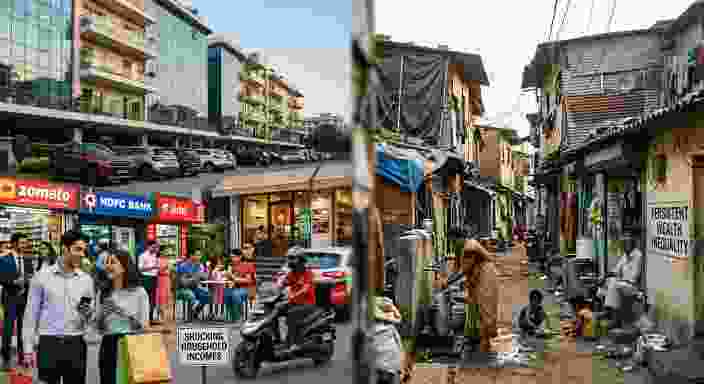
Shifting Tides: India’s Rising Household Incomes vs. Persistent Wealth Inequality
- Editor
- September 23, 2026
- Uncategorized
- 0 Comments
New Delhi, September 2026 — India’s economic narrative is undergoing a striking paradox. While average household incomes are steadily rising and pulling millions out of poverty, the country’s wealth inequality remains staggeringly high. Recent data reveals a booming middle and upper-middle class, yet acute concentration of wealth at the very top continues to define the nation’s socio-economic landscape.
The Evolving Income Pyramid: Shrinking Bottom, Growing Top
Data cited from recent Red Herring Prospectus (RHP) filings highlights a significant structural shift in India’s income distribution between FY21 and projections for FY31:
- The Low-Income Shrinkage: Households earning less than ₹3 lakh annually—which stood at a massive 13.5 crore in FY21—dropped to 11.9 crore in FY26 and are projected to decline further to 9.8 crore (25.86% of the population) by FY31.
- The Stable Middle Class: The core segment earning between ₹3 lakh and ₹8 lakh annually remains steady, moving from 11 crore households in FY26 to 11.9 crore by FY31.
- The Upper-Middle Surge: Households in the ₹8 to ₹10 lakh bracket are expected to jump sharply from 7.4 crore in FY26 to 9.8 crore by FY31, growing their population share from 21.2% to 25.86%.
- The Affluent Expansion: High-income households earning above ₹10 lakh annually are projected to expand from 4.6 crore to 6.4 crore households, raising their population share from 13.18% to 16.89%.
In total, households earning ₹8 lakh or more are set to surge from 12 crore in FY26 to 16.2 crore by FY31, signaling a broader capacity for spending and saving.
Financialization Beyond the Metros
Higher earnings are translating into changing financial habits. MOSPI data notes that household and non-profit institutional gross savings reached 21.67% of GDP in FY25.
Crucially, this financial boom is no longer limited to major metropolitan areas. Mutual Fund Assets Under Management (AUM) from Tier-2 and Tier-3 cities (B30 cities) nearly tripled—surging from ₹5.36 trillion in March 2021 to nearly ₹14 trillion (₹13.89 trillion) by March 2026. This marks a structural shift as ordinary households increasingly pivot from traditional physical assets to market-linked financial instruments driven by better digital access and financial literacy.
The Great Divide: Wealth Concentration at the Top
Despite millions entering higher income brackets, wealth creation remains profoundly skewed. RHP estimates indicate that the top 10% of adults (roughly 14.6 crore people) held about 65% of total wealth in 2025.
Experts note that even high monthly earnings do not guarantee financial ease. Making ₹2 lakh a month places an individual comfortably among the top 1% to 5% of earners in India. Yet, affording a home in a metropolitan city on that salary remains an uphill battle, forcing buyers to rely heavily on long-term debt.
Bottom Line
India’s average income is undoubtedly on an upward trajectory, creating a thriving consumer class. However, severe income inequality means that the fruits of economic growth are heavily concentrated at the top. Until wealth distribution becomes more broad-based, acute disparity will remain the defining challenge of India’s economic ascent.