Pakistan Signals Formation of ‘Islamic NATO’ as Turkey and Qatar Eye Saudi Defense Pact
- Editor
- May 16, 2026
- Uncategorized
- 0 Comments
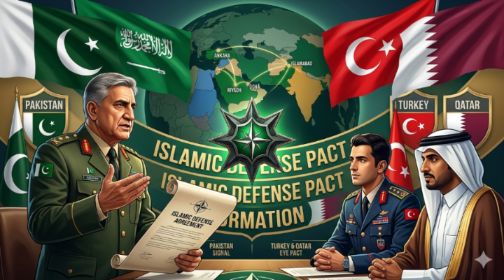
Islamabad, May 2026 — The geopolitical architecture of the Middle East and South Asia is on the verge of a seismic shift. What began as a bilateral defense pact between Saudi Arabia and Pakistan in 2025 is rapidly evolving into a potential ‘Islamic NATO’, with Turkey and Qatar reportedly preparing to join the ranks.
What proponents call a necessary step toward regional self-reliance, geopolitical analysts describe as a volatile marriage of convenience that could severely complicate global security dynamics.
The Decline of the American Umbrella For decades, Gulf monarchies relied on a simple security guarantee: if attacked, the United States would intervene. That illusion has shattered. From the muted US response to the 2019 attacks on Saudi oil facilities to the chaotic Afghanistan withdrawal and the spillover of the 2026 Israel-Iran war, regional powers have realized the American shield is no longer dependable. The formation of this Islamic military bloc is a direct reaction to Washington’s waning reliability.
Four Pillars, Four Different Agendas While pitched as a unified Islamic front, the alliance is fundamentally a transactional arrangement where each nation brings a specific asset to the table:
- Pakistan (The Muscle): Islamabad brings the ultimate deterrent—nuclear weapons—along with one of the world’s largest standing armies and crucial strategic geography. In return, a desperate Pakistan seeks massive economic lifelines and investment from the Gulf.
- Saudi Arabia (The Wallet): Riyadh offers immense oil wealth and the religious legitimacy of hosting Islam’s holiest sites. Its goal is to establish an independent regional deterrence against Iran without begging for Western help.
- Turkey (The Tech Engine): Despite being a Western NATO member, Ankara wants to expand its influence across the Muslim world. It brings cutting-edge military technology, specifically its world-class drone manufacturing and missile systems, to the bloc.
- Qatar (The Facilitator): Doha provides deep pockets and unmatched diplomatic mediation networks, acting as the financial and logistical glue for the alliance.
Alarm Bells in New Delhi For India, the formalization of this bloc is a strategic nightmare. The immediate threat is the unchecked flow of advanced Turkish military technology and drones directly into Pakistan’s arsenal. Furthermore, India has spent years carefully balancing its relationships with Saudi Arabia, the UAE, and Israel. If the Middle East polarizes into a single, organized military bloc heavily influenced by Pakistan and Turkey—both of whom frequently coordinate anti-India narratives over Kashmir—New Delhi’s diplomatic tightrope will become incredibly dangerous. It also threatens to alter the maritime security calculations in the Arabian Sea.
A House Divided? Despite the rapid negotiations, the foundation of this ‘Islamic NATO’ is fragile. Western NATO thrives on the principle of a shared adversary; this new bloc has none. Saudi Arabia’s primary enemy is Iran. Pakistan’s sole focus is India. Turkey is preoccupied with Kurdish militancy. Add to this the intense internal rivalries—such as Turkey and Saudi Arabia’s ongoing battle for leadership of the Sunni world—and the alliance looks less like a unified military command and more like a fragile pact of convenience.
Bottom Line The era of relying entirely on Western security in the Middle East is ending. With the ‘Islamic NATO’ taking shape, the masks of total unity are on, but the underlying reality remains complex: it is a formidable grouping of wealth, tech, and nuclear power, yet it is bound together more by a shared distrust of the West than by a truly unified vision for the future.