The Horror of 1995: How the Tandoor Case Shocked the Nation
- Editor
- May 16, 2026
- Uncategorized
- 0 Comments
NEW DELHI, May 2026 — It remains one of the most chilling chapters in India’s criminal history. What began as a toxic domestic dispute within the upper echelons of political youth leadership ended in a gruesome murder that fundamentally transformed the country’s forensic and legal frameworks. Thirty years later, the “Tandoor Case” is still studied as a definitive masterclass in criminal investigation and a stark warning about the destructive nature of unchecked obsession.
A Power Couple Ruined by Obsession In the early 1990s, Sushil Sharma and Naina Sahni were rising stars in the Delhi Youth Congress. After secretly marrying in 1993, they moved into a flat in Delhi’s Gole Market. However, the four walls of their home quickly became a battleground. Sushil, intensely possessive and controlling, grew deeply paranoid over Naina’s completely normal social interactions, developing a severe fixation on her old college friend and party worker, Matloob Karim. Suffocated by Sushil’s behavior, Naina began quietly finalizing plans to escape the marriage by relocating to Australia.
The Fatal Spark The tension boiled over on the hot summer evening of July 2, 1995. Sushil returned home unexpectedly to find Naina drinking and talking on the phone. Startled, she abruptly hung up. Driven by suspicion, Sushil redialed the number, only to hear Matloob’s voice on the line. In a flash of blind rage, Sushil pulled out his licensed .32 caliber revolver and fired three shots. Two bullets struck Naina in the head and neck, killing her instantly on the living room floor.
The Grisly Cover-Up at Bagiya Restaurant What followed next horrified the nation. Desperate to erase his crime, Sushil wrapped Naina’s body in a heavy black plastic sheet and a bedsheet, stashed it in the back seat of his white Maruti car, and drove around Delhi looking for a way to dispose of it.
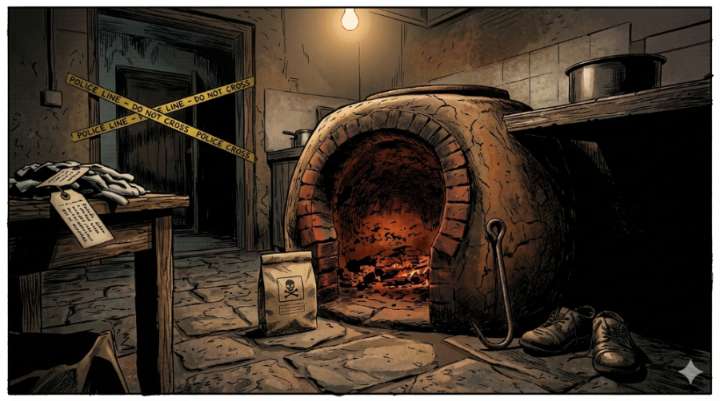
He eventually headed to the Bagiya Barbeque restaurant at the Ashok Yatri Niwas complex, where he was an influential partner. Believing his own staff would protect him, Sushil enlisted the restaurant manager, Keshav Kumar. Together, they stuffed Naina’s body into the open-air clay tandoor usually reserved for roasting kebabs. To accelerate the burning process and completely incinerate the physical evidence, they repeatedly fueled the fire with large quantities of wood, paper, and over 500 grams of butter.
A Constable’s Instinct Foils the Plot The horrific plan collapsed entirely due to the sharp instincts of Delhi Police Constable Abdul Nazir Kunju. While on night patrol, Kunju noticed an unusually thick, white smoke billowing from the restaurant, accompanied by an unmistakable, foul odor. Scaling the restaurant’s boundary wall to investigate, Kunju stumbled upon a nightmare: a human torso melting inside the roaring tandoor. While Keshav Kumar was pinned down and caught red-handed, Sushil Sharma managed to slip away into the night, initiating a massive nine-day nationwide manhunt before finally surrendering to police in Bangalore.
The Trial That Pioneered Forensic DNA Because the body was severely charred, traditional identification was completely impossible, and defensive lawyers quickly claimed the corpse belonged to an unknown person. The crisis forced Indian investigators to lean heavily on an entirely new scientific frontier: forensic DNA profiling. In a historic first for Indian criminal justice, tissue samples were sent to CCMB Hyderabad, where experts successfully matched the remains to Naina’s parents, scientifically shattering the defense’s arguments and forever changing how complex crimes are prosecuted in India.
Bottom Line The legal battle spanned decades. The trial court initially sentenced Sushil Sharma to death, classifying the horrific attempt to destroy a human body in an oven as a “rarest of rare” crime. However, in 2013, the Supreme Court commuted the sentence to life imprisonment, ruling that the murder was a tragic byproduct of a strained personal relationship rather than a premeditated terrorist act. After serving 23 disciplined years in prison, Sharma was released by the Delhi High Court in 2018—leaving behind a legacy that permanently institutionalized DNA forensics in the bedrock of Indian law.