India vs. Pakistan: The New “Water Terrorism” Frontier
- Editor
- May 2, 2026
- Uncategorized
- 0 Comments
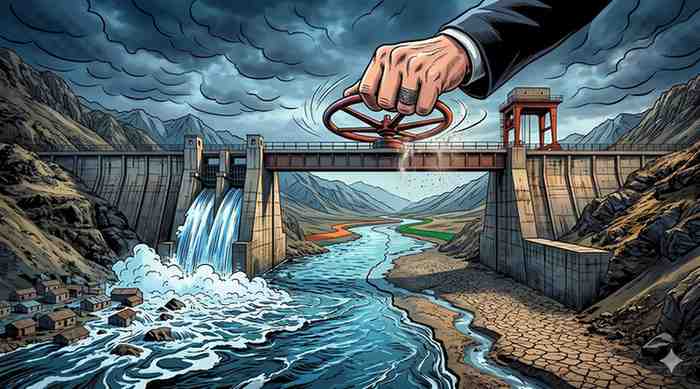
New Delhi, May 2026 — While the guns along the Line of Control remain silent, a new, invisible war has erupted between India and Pakistan. This conflict isn’t over territory, but over the very resource civilizations are built upon: water. Pakistan has recently escalated its rhetoric, accusing India of “Water Terrorism” and using the Indus waters as a strategic weapon.
The 1960 Indus Waters Treaty: A Historical Anomaly
For over six decades, the Indus Waters Treaty (IWT), brokered by the World Bank, has governed the sharing of six rivers. Under the agreement, India was allocated the three eastern rivers (Ravi, Beas, Sutlej), while Pakistan received the three western rivers (Indus, Jhelum, Chenab).
The strategic irony is stark: despite being the upstream nation, India voluntarily ceded control of 80% of the total water volume to Pakistan—a level of generosity unparalleled in global diplomacy. For years, India upheld the treaty through multiple wars, but that “strategic patience” has finally reached its breaking point.
“Blood and Water Cannot Flow Together”
The tide turned following a 2025 terror attack in Pahalgam, Kashmir. India’s response was swift and uncompromising: a decision to hold the treaty in abeyance. New Delhi’s doctrine—that “blood and water cannot flow together”—has transitioned from a slogan to a firm policy.
Pakistan, whose economy and 80% of its agriculture depend entirely on these waters, has reacted with desperation. It is now attempting to internationalize the issue, seeking intervention from the International Court of Justice (ICJ) and the UN.
The Legal and Narrative Battle
India’s strategy is twofold:
- Legal Sovereignty: India insists the IWT has its own autonomous dispute resolution mechanism—starting with the Permanent Indus Commission—and rejects any “third-party” intervention like the ICJ.
- Technological Defense: India maintains that its hydroelectric projects are “run-of-the-river,” meaning they use the river’s energy without consuming or permanently stopping the water flow, a right granted by the treaty itself.
Geopolitical Fallout: A Global Precedent?
Pakistan’s attempt to paint India as a “regional bully” is being met by a firm, “logic-first” Indian diplomacy. New Delhi’s message is clear: treaties are built on trust, and trust cannot be a one-way street while cross-border terrorism continues.
This standoff has implications far beyond the subcontinent. As climate change makes water a high-stakes resource, the resolution of this dispute could set a global precedent for how upstream nations redefine old treaties based on national security.
Bottom Line
The era of India playing a purely defensive diplomatic game is over. By utilizing its “geopolitical advantage” over water resources, India has turned a decades-old treaty into a powerful piece of leverage. [00:08:20] For Pakistan, the “red line” of water security has been crossed; for India, it is a matter of protecting its sovereignty against state-sponsored terror.