Singapore Retains Top FDI Source Status for India: What Sustained Capital Flows Mean for Investment Policy
- admin
- April 18, 2026
- Uncategorized
- 0 Comments
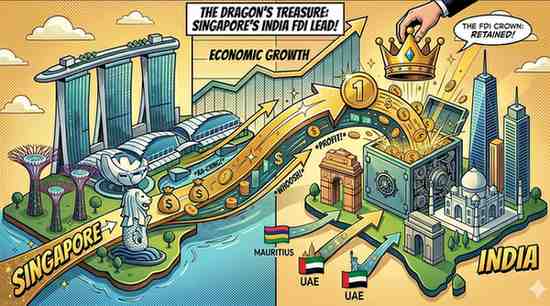
Singapore remains the largest source of foreign direct investment into India in 2026, maintaining a position it has held for several consecutive years due to treaty benefits and its role as a financial hub for Asia-Pacific capital. The city-state’s dominance reflects both legitimate investment routing and India’s continued attractiveness to global institutional capital seeking emerging market exposure.
New Delhi, April 2026 — Singapore has once again emerged as the top source of FDI equity inflows into India, channelling an estimated $12-14 billion in the current fiscal year through March 2026, according to Department for Promotion of Industry and Internal Trade data. The sustained primacy of the Southeast Asian financial centre underscores structural patterns in how global capital accesses Indian markets.
Why Does Singapore Dominate India’s FDI Inflows?
Singapore’s position as India’s largest FDI source stems from its status as a regional treasury and holding company jurisdiction for multinational corporations and private equity funds. The India-Singapore Comprehensive Economic Cooperation Agreement provides favourable tax treatment on capital gains, making Singapore an efficient conduit for investments originating from the United States, Europe and Japan. Major sovereign wealth funds including GIC and Temasek maintain substantial India allocations routed through Singapore-domiciled vehicles.
What Does This Mean for India’s Investment Landscape?
India’s reliance on Singapore-routed FDI creates both opportunities and policy complexities for New Delhi. The consistent capital flow validates India’s position as a preferred emerging market destination, particularly in technology, financial services and manufacturing sectors. However, policymakers must distinguish between genuine Singaporean investment and round-tripped Indian capital or third-country funds using Singapore as a pass-through jurisdiction to exploit treaty benefits.
How Does This Compare to Historical Patterns?
Singapore overtook Mauritius as India’s top FDI source in 2019-20 following amendments to the India-Mauritius tax treaty that eliminated capital gains exemptions. The shift demonstrated how treaty architecture directly shapes FDI geography rather than underlying economic relationships. Before 2016, Mauritius accounted for over 35 percent of cumulative FDI into India, a position now occupied by Singapore with approximately 25-28 percent of annual equity inflows.
- Singapore FDI into India exceeded $12 billion in FY2025-26, maintaining year-on-year growth of 8-10 percent
- Mauritius, United States, Netherlands and Japan constitute the remaining top five FDI sources
- Services sector, computer software and hardware, and trading activities attract the largest Singapore-origin investments
- Maharashtra, Karnataka and Delhi-NCR receive the highest concentration of Singapore-routed capital
- India attracted total FDI inflows exceeding $70 billion in FY2025-26 across all source countries
What Should Investors and Policymakers Watch?
India’s ongoing negotiations on bilateral investment treaties and potential revisions to the Singapore CECA merit close monitoring by institutional investors. The government’s production-linked incentive schemes have begun attracting manufacturing FDI that bypasses traditional Singapore routing, potentially diversifying source country patterns. UAE has emerged as a rising FDI source following the 2022 trade agreement, signalling geographic diversification in India’s capital inflow profile.
Analyst’s View
Singapore’s continued dominance as India’s FDI gateway reflects the maturation of India’s capital account liberalisation rather than any single policy initiative. Investors should expect this pattern to persist through the decade unless India pursues aggressive treaty renegotiations or implements stricter beneficial ownership disclosure requirements. The more significant metric for assessing India’s investment attractiveness remains sector-wise FDI composition—a shift toward manufacturing and infrastructure from services would signal genuine economic transformation beyond financial engineering.