Hormuz Strait Blockade Threat Exposes India’s Energy Security Vulnerability as US-Iran Tensions Escalate
- admin
- April 16, 2026
- Uncategorized
- 0 Comments
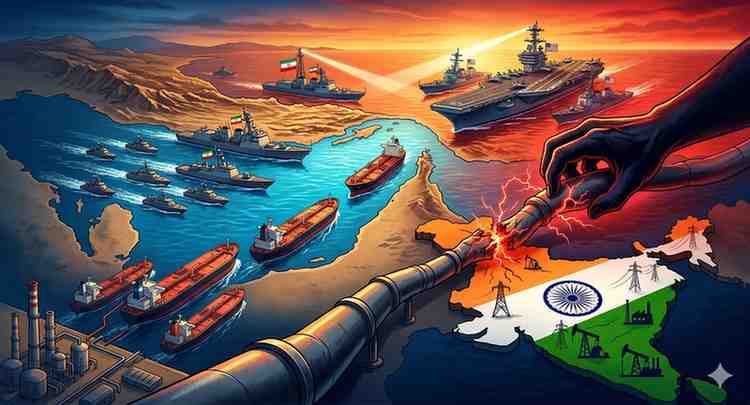
The Trump administration’s threat to blockade the Strait of Hormuz as part of intensified pressure on Iran directly endangers India’s energy security, with approximately 60% of India’s crude imports transiting through this critical chokepoint. Both India and China face immediate supply disruption risks, forcing New Delhi to accelerate strategic petroleum reserve expansion and diversify sourcing away from Gulf dependence.
New Delhi, April 2025 — The Strait of Hormuz, a 33-kilometre-wide passage between Oman and Iran, now sits at the centre of a geopolitical standoff that threatens to upend energy markets across Asia. The Trump administration’s signalling of potential blockade measures against Iranian oil exports represents the most aggressive US posture in the Gulf since the 2019 tanker attacks, placing the world’s two largest oil importers — China and India — squarely in the crosshairs of American sanctions enforcement.
What Is Driving the US Blockade Threat?
Washington’s escalation stems from frustration over Iran’s continued nuclear enrichment activities and its expanding influence across the Middle East. The Trump administration has reportedly grown impatient with diplomatic channels and is considering naval interdiction to enforce maximum pressure on Tehran’s oil revenues. This approach mirrors the aggressive sanctions posture of Trump’s first term but adds a kinetic dimension that dramatically raises stakes for transit nations. American strategists calculate that choking Iran’s primary revenue source will force concessions, though critics warn this risks direct military confrontation.
What Does This Mean for India?
India’s energy security faces acute exposure to Hormuz disruption given its structural dependence on Gulf crude. Indian refiners have already begun stress-testing alternative supply scenarios, with Indian Oil Corporation and Bharat Petroleum reportedly in discussions with Russian and African suppliers for contingency volumes. New Delhi’s strategic petroleum reserves currently cover only 9.5 days of consumption — far below the IEA-recommended 90 days — making prolonged disruption economically catastrophic. The Ministry of External Affairs faces a diplomatic tightrope: maintaining energy ties with Iran while preserving the increasingly vital US strategic partnership.
How Does This Compare to Previous Disruptions?
The 2019 Abqaiq-Khurais attacks in Saudi Arabia temporarily removed 5.7 million barrels per day from global supply, causing a 15% single-day oil price spike. A full Hormuz blockade would dwarf that disruption, potentially removing 17-21 million barrels per day from markets. During the 1980s Tanker War, Lloyd’s of London raised insurance premiums by 400%, a pattern likely to repeat if hostilities materialise. India’s current account deficit, already under pressure at 1.8% of GDP, could widen sharply with every $10 per barrel increase in crude prices.
- Approximately 17 million barrels of oil transit the Strait of Hormuz daily, representing 20% of global consumption
- India imports 88% of its crude oil requirements, with 60% sourced from Gulf nations
- China imported 1.5 million barrels per day from Iran in 2024 despite US sanctions
- Indian strategic petroleum reserves stand at 39 million barrels, covering 9.5 days of consumption
- Shipping insurance premiums for Hormuz transit have risen 35% since February 2025
What Should Investors Watch?
Energy sector volatility will directly impact Indian upstream companies like ONGC and downstream refiners including Reliance Industries. Investors should monitor freight rate indices for Very Large Crude Carriers, which serve as leading indicators of supply stress. The rupee faces depreciation pressure if oil prices sustain above $95 per barrel, historically triggering RBI intervention. Defence stocks may see renewed interest as New Delhi accelerates naval modernisation focused on Indian Ocean sea-lane protection.
Analyst’s View
The Hormuz blockade threat exposes a structural vulnerability that Indian policymakers have acknowledged but inadequately addressed for decades. New Delhi must now treat energy diversification as a national security imperative rather than an economic preference. The coming weeks will reveal whether this crisis catalyses genuine strategic petroleum reserve expansion and accelerated renewable transition, or merely prompts short-term diplomatic manoeuvring. Watch for emergency Cabinet Committee on Security meetings and any deviation from India’s traditionally neutral Gulf posture as key signals of policy recalibration.