IMF Downgrades Global Growth Forecasts as Trade Tensions Push World Economy Toward Recession Risk
- admin
- April 15, 2026
- Uncategorized
- 0 Comments
The International Monetary Fund has cut its global growth projections, warning that the world economy is already drifting toward a more adverse scenario characterised by fragmented trade and persistent uncertainty. The revision signals mounting risks for emerging markets including India, which faces potential headwinds from weakening export demand and volatile capital flows.
New Delhi, April 2025 — The IMF’s latest World Economic Outlook delivers its starkest warning since the pandemic recovery period, acknowledging that baseline assumptions underpinning earlier forecasts have deteriorated faster than anticipated. The Fund’s admission that the global economy is trending toward its own worst-case projections represents a significant shift from the cautious optimism that marked its January update.
What Is Driving the IMF’s Downgrade?
Escalating trade policy uncertainty stands at the centre of the IMF’s revised outlook, with tariff escalations between major economies disrupting supply chains and dampening business investment. The Fund has noted that policy unpredictability itself—separate from actual tariff implementation—is suppressing capital expenditure decisions across both advanced and emerging economies. Financial conditions have tightened globally as investors reprice risk assets amid growing recession probabilities. The IMF’s models suggest that prolonged trade fragmentation could permanently reduce global GDP by 1.5 to 2 percentage points over the medium term.
What Does This Mean for India?
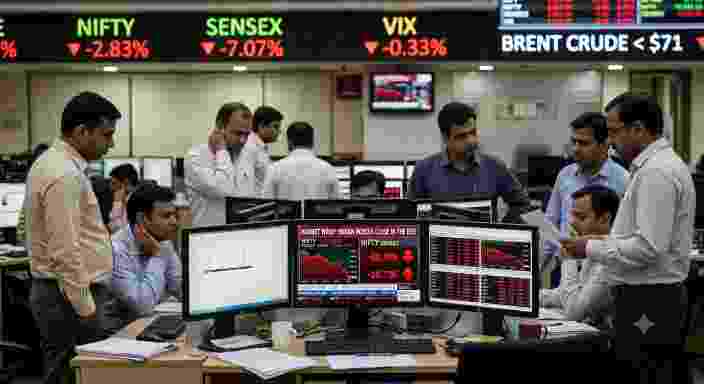
India’s export-dependent sectors face near-term pressure as demand softens in key markets including the United States and European Union. The Reserve Bank of India may encounter a more complex policy environment, balancing the need to support growth against imported inflation risks from a potentially weaker rupee. Foreign portfolio investment flows into Indian equities and debt could turn volatile if global risk appetite continues deteriorating. India’s relative insulation from direct US-China trade tensions provides some buffer, but second-order effects through commodity prices and global demand channels remain material.
How Does This Compare to Previous IMF Warnings?
The IMF’s current posture echoes its April 2019 downgrade cycle, when trade war concerns similarly dominated the outlook—though the present warning carries greater urgency. The Fund had revised global growth upward as recently as October 2024, making this reversal particularly sharp in institutional terms. Previous drift-to-adverse-scenario warnings in 2008 and 2020 preceded significant market corrections, though causality remains debated among economists.
- Global growth forecast cut from 3.3% to an unspecified lower baseline, with adverse scenario projecting sub-2.5% expansion
- Trade policy uncertainty index at highest level since 2020 pandemic peak
- Emerging market capital outflows reached $45 billion in Q1 2025, highest quarterly figure since 2022
- IMF warning arrives ahead of Spring Meetings scheduled for late April in Washington
- Fund previously upgraded India’s 2025 growth forecast to 6.5% in January—revision now likely
What Should Investors Watch?
Currency markets will provide the earliest signal of stress transmission to emerging economies, with the rupee’s stability against a potentially strengthening dollar requiring close monitoring. Corporate earnings guidance from export-oriented Indian IT and pharmaceutical companies in the upcoming quarter will reveal demand trajectory in Western markets. The RBI’s liquidity management and any shift in its monetary policy stance at the June review will indicate domestic policymakers’ assessment of external risks.
Analyst’s View
The IMF’s acknowledgment that reality is converging with its adverse scenario removes a psychological buffer that markets had maintained between baseline and tail-risk projections. Indian policymakers should accelerate contingency planning for a sub-6% growth environment, particularly given the fiscal constraints limiting counter-cyclical spending capacity. The next thirty days—spanning the IMF Spring Meetings and potential trade negotiation developments—will determine whether this warning becomes a self-correcting signal or a confirmed trajectory toward global slowdown.