Why Malaysia Has Become India’s Strategic Anchor in Southeast Asia Under Act East 2.0
- admin
- April 11, 2026
- Uncategorized
- 0 Comments
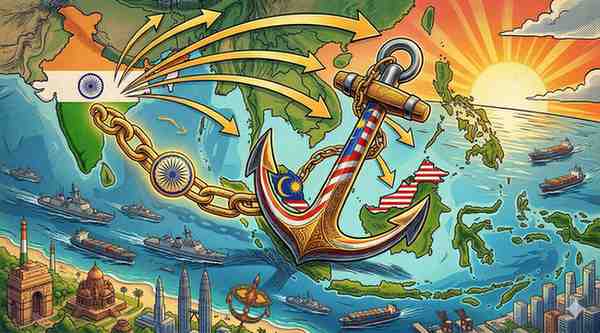
Malaysia has emerged as a pivotal partner in India’s Act East Policy, driven by converging interests in trade diversification, maritime security, and supply chain resilience amid intensifying US-China competition. New Delhi’s diplomatic recalibration positions Kuala Lumpur as a gateway to ASEAN’s $3.6 trillion economy and a counterweight to Beijing’s expanding regional footprint.
New Delhi, April 2026 — India-Malaysia bilateral trade crossed $19.4 billion in 2024-25, marking a 12% year-on-year increase and cementing Malaysia’s position as India’s third-largest trading partner within ASEAN, behind only Singapore and Indonesia. This commercial momentum reflects a deeper strategic realignment that extends well beyond transactional economics into defence cooperation, semiconductor supply chains, and maritime domain awareness.
What Is Driving India’s Renewed Focus on Malaysia?
India’s strategic calculus towards Malaysia has shifted significantly since the Modi government’s Act East Policy 2.0 framework prioritised defence and connectivity over legacy cultural diplomacy. Malaysia’s location along the Strait of Malacca — through which 40% of global trade and 80% of India’s crude oil imports transit — makes it indispensable to New Delhi’s Indo-Pacific security architecture. Kuala Lumpur’s measured approach to China, maintaining economic ties while resisting overt alignment, offers India a pragmatic partner rather than an ideological ally. The 2023 elevation of bilateral ties to an Enhanced Strategic Partnership formalised this recalibration.
What Does This Mean for India’s Regional Ambitions?
India gains a credible entry point into ASEAN’s integrated manufacturing ecosystem at a moment when Western multinationals are actively pursuing China-plus-one strategies. Malaysia’s semiconductor packaging and testing industry — which handles 13% of global output — aligns with India’s ambitions to build domestic chip capabilities through technology transfer arrangements. New Delhi’s defence exports to Kuala Lumpur, including the proposed sale of Tejas light combat aircraft, would mark India’s first major military aviation deal in Southeast Asia. Malaysia also provides diplomatic ballast for India’s positions on South China Sea disputes without requiring New Delhi to adopt confrontational postures.
How Does This Compare to India’s Other ASEAN Partnerships?
India-Malaysia relations have historically lagged behind India-Singapore and India-Vietnam ties in strategic depth, partly due to periodic political friction over Kashmir-related statements from Kuala Lumpur. The relationship’s trajectory now more closely resembles India’s partnership with the UAE — transactional at its core but increasingly institutionalised through joint working groups on defence, fintech, and green energy. Unlike Vietnam, which shares India’s direct territorial anxieties vis-à-vis China, Malaysia offers commercial complementarity rather than security convergence.
- India-Malaysia bilateral trade reached $19.4 billion in 2024-25, up 12% year-on-year
- Malaysia handles 13% of global semiconductor packaging and testing capacity
- The Strait of Malacca carries 40% of global maritime trade annually
- Indian diaspora in Malaysia numbers approximately 2.1 million, the largest in Southeast Asia
- Defence cooperation MoU signed in 2023 covers joint exercises, training, and equipment procurement
What Should Policymakers and Investors Watch?
India’s proposed Comprehensive Economic Cooperation Agreement with Malaysia, stalled since 2010, has re-entered preliminary discussions with both governments targeting 2027 for conclusion. Progress on semiconductor cooperation will depend on whether Indian firms secure meaningful roles in Malaysian supply chains or remain confined to lower-value segments. The scheduled 2026 joint naval exercise in the Andaman Sea will test operational interoperability and signal the partnership’s defence trajectory to regional observers.
Analyst’s View
Malaysia represents India’s most underutilised strategic asset in Southeast Asia — a middle power with economic heft, geographic criticality, and sufficient autonomy from Beijing to engage New Delhi substantively. The relationship’s ceiling will be determined by India’s capacity to deliver on commercial promises rather than diplomatic declarations. Fund managers should monitor Malaysian semiconductor firms with Indian joint venture exposure, while defence sector analysts should track Tejas export negotiations as a bellwether for India’s credibility as an alternative arms supplier in the region.