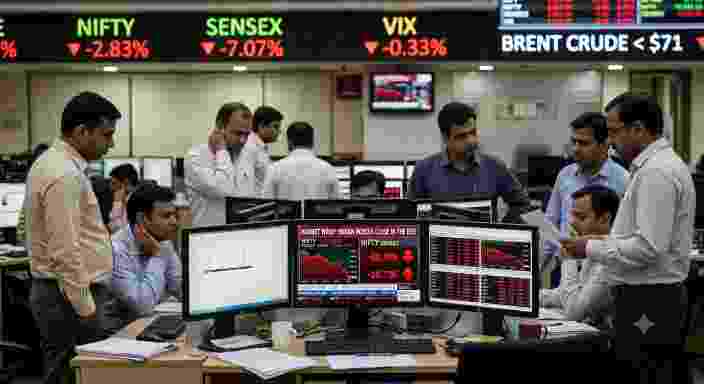
Indian Equity Markets Face Volatile Opening as Global Uncertainty and Domestic Cues Collide
- admin
- April 11, 2026
- Uncategorized
- 0 Comments
Indian benchmark indices Sensex and Nifty face a mixed opening on Friday amid conflicting signals from global markets and domestic institutional flows. Traders should anticipate heightened intraday volatility as markets digest overnight developments from US futures and Asian equities alongside quarterly earnings momentum.
New Delhi, April 2026 — The Bombay Stock Exchange’s Sensex and the National Stock Exchange’s Nifty 50 enter Friday’s session with market participants divided on directional conviction, following a week marked by sectoral rotation and foreign institutional investor caution. Gift Nifty futures trading in Gujarat’s GIFT City indicated a flat-to-marginally positive opening, suggesting that neither bulls nor bears have established clear control ahead of the cash market session.
What Is Driving Market Sentiment Today?
Multiple factors are converging to create an uncertain trading environment for Indian equities. Asian markets traded mixed overnight, with Japan’s Nikkei showing resilience while Chinese indices remained under pressure from ongoing property sector concerns. Foreign Institutional Investors have maintained a cautious stance through April, with net outflows totalling approximately ₹4,200 crore in the first week alone. Domestic Institutional Investors, however, have provided consistent support, absorbing selling pressure through systematic investment plan inflows and insurance company allocations.
What Does This Mean for Indian Investors?
Retail and institutional investors must navigate a market environment where index-level stability masks significant sectoral divergence. Banking and financial services stocks remain sensitive to evolving expectations around the Reserve Bank of India’s monetary policy trajectory. Information technology shares continue facing headwinds from rupee strength and concerns over US corporate technology spending. Defensive sectors including FMCG and pharmaceuticals have attracted rotation flows as investors seek earnings visibility amid macroeconomic uncertainty.
How Does Current Volatility Compare Historically?
The India VIX, measuring implied volatility expectations, has traded in an elevated 14-16 range through early April, compared to sub-12 levels witnessed during the January rally. Market breadth indicators suggest that participation has narrowed considerably, with fewer than 40 percent of Nifty 500 constituents trading above their 50-day moving averages. The last comparable period of concentrated leadership occurred during September 2024, preceding a 7 percent index correction over subsequent weeks.
- Sensex closed at 79,425 in the previous session, down 0.3 percent
- Foreign Institutional Investors sold ₹1,847 crore in equities on Thursday
- Domestic Institutional Investors purchased ₹2,156 crore, providing net support
- India VIX stands at 15.2, indicating elevated near-term uncertainty
- Nifty’s immediate support zone lies at 24,100, with resistance near 24,450
What Should Investors Watch in Today’s Session?
Quarterly earnings announcements from mid-cap IT services companies and select private sector banks will influence sectoral sentiment during the session. Global crude oil price movements remain critical for inflation expectations and consequently for rate-sensitive stocks. The rupee’s behaviour against the dollar, currently trading near 83.40, will determine foreign investor hedging costs and allocation decisions. Options expiry-related positioning could amplify moves in either direction as weekly contracts settle.
Analyst’s View
Indian equity markets are transitioning from liquidity-driven optimism toward a more discerning phase where earnings delivery will determine individual stock trajectories. The structural growth narrative supporting Indian assets remains intact, supported by robust domestic consumption and infrastructure spending. However, near-term returns will likely compress as valuations digest earlier gains. Investors should monitor the upcoming RBI policy guidance and US Federal Reserve commentary for cues on the interest rate differential that influences foreign flows into emerging market equities including India.