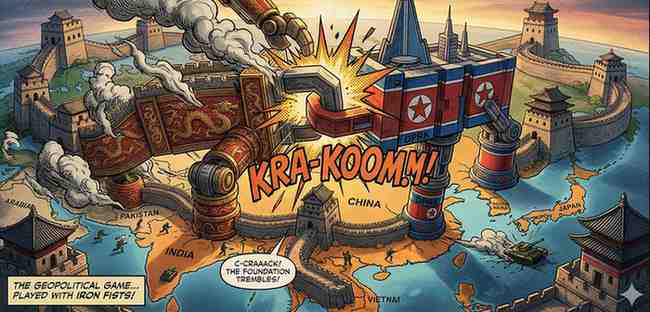
China-North Korea Diplomatic Reset: What the Renewed Engagement Means for Asian Security Architecture
- admin
- April 10, 2026
- Uncategorized
- 0 Comments
China and North Korea are resuming high-level diplomatic exchanges after years of pandemic-induced isolation, signalling Beijing’s renewed interest in stabilising its buffer state amid intensifying US-led pressure in the Indo-Pacific. The diplomatic thaw carries significant implications for regional security calculations, including India’s strategic positioning in a multipolar Asia.
New Delhi, April 2025 — The resumption of formal diplomatic engagement between Beijing and Pyongyang marks the most significant bilateral reset since Kim Jong Un’s last visit to China in January 2019, ending a prolonged hiatus that saw North Korea retreat into extreme isolation during the COVID-19 pandemic.
What Is Driving This Diplomatic Reset?
China’s renewed outreach to North Korea reflects Beijing’s broader strategy of consolidating influence among allied states as competition with the United States intensifies across the Pacific theatre. Pyongyang’s deepening military cooperation with Russia, including alleged arms transfers for the Ukraine conflict, has complicated China’s position as the Korean Peninsula’s primary external stakeholder. Beijing appears determined to reassert its relevance in North Korean strategic calculations before Moscow’s influence becomes entrenched. The timing also coincides with heightened US-South Korea-Japan trilateral coordination, which Beijing views as de facto containment architecture.
What Does This Mean for India?
India’s strategic community will monitor this rapprochement closely, given its implications for China’s capacity to manage multiple pressure points simultaneously. A stabilised China-North Korea axis allows Beijing to concentrate diplomatic and military resources on contested frontiers, including the Line of Actual Control with India. New Delhi has historically maintained limited diplomatic contact with Pyongyang, but the emerging China-Russia-North Korea alignment reinforces India’s rationale for deepening Quad engagement. Indian policymakers must also assess how renewed Chinese patronage affects North Korea’s nuclear and missile calculus, given the peninsula’s proximity to critical Indian Ocean shipping lanes.
How Does This Compare to Previous Engagement Cycles?
The last substantive China-North Korea diplomatic cycle occurred between 2018-2019, when Kim Jong Un made four visits to China amid his summitry with US President Donald Trump. That engagement collapsed following the failed Hanoi summit in February 2019, after which Pyongyang retreated and Beijing’s leverage appeared diminished. The current reset occurs in a fundamentally altered geopolitical context, with Russia now serving as an alternative patron and North Korea having conducted over 100 missile tests since 2022. China’s bargaining position has weakened relative to 2018, making the terms of renewed engagement a critical variable.
- Kim Jong Un last visited China in January 2019, making this the longest gap in leader-level contact since the 1950s
- North Korea conducted 31 missile launches in 2024 alone, according to South Korean military tracking
- China accounts for over 90% of North Korea’s external trade, estimated at USD 2.3 billion annually
- Russia-North Korea trade surged 4.7 times in 2023, reaching approximately USD 34 million, per Russian customs data
- The US has deployed additional strategic assets to the Korean Peninsula, including nuclear-capable bombers, since 2023
What Should Strategic Observers Watch?
The critical indicators will be whether Beijing secures any commitments from Pyongyang regarding missile testing frequency or nuclear development pace. Markets and governments should monitor Chinese economic concessions, particularly any relaxation of informal sanctions enforcement at the Dandong border crossing. The sequencing of visits—whether Kim travels to Beijing or Xi Jinping sends senior envoys first—will signal the hierarchy of the renewed relationship. Any joint statements on Taiwan or South China Sea issues would indicate North Korea’s integration into China’s broader regional messaging strategy.
Analyst’s View
The China-North Korea diplomatic resumption represents Beijing’s pragmatic recalibration rather than strategic triumph. China faces the uncomfortable reality that its most dependent ally has diversified toward Moscow, reducing Pyongyang’s vulnerability to Chinese pressure. For India and other regional stakeholders, the key takeaway is that the emerging authoritarian alignment in Northeast Asia—while often overstated—creates new coordination challenges for the democratic security architecture. The next ninety days will reveal whether Beijing can translate renewed dialogue into meaningful influence over North Korean behaviour, or whether this engagement remains largely ceremonial while Russia consolidates its newfound role.