RBI’s 4.6% Inflation Forecast for FY27 Reflects Cautious Optimism Amid Geopolitical Uncertainty
- admin
- April 10, 2026
- Uncategorized
- 0 Comments
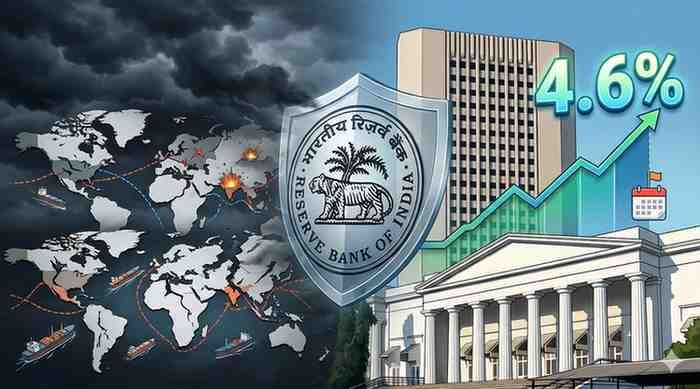
The Reserve Bank of India under Governor Sanjay Malhotra has projected headline inflation at 4.6% for FY2026-27, positioning price stability within the central bank’s comfort zone despite elevated global risks. This forecast signals measured confidence in domestic price dynamics while acknowledging that geopolitical flashpoints could rapidly alter the inflation trajectory.
New Delhi, April 2026 — The RBI’s Monetary Policy Committee has anchored its FY27 inflation projection at 4.6%, a figure that sits comfortably below the upper threshold of the central bank’s 2-6% tolerance band but notably above the 4% medium-term target. Governor Sanjay Malhotra’s first full-year inflation outlook since assuming office reflects an institution navigating between domestic price stabilisation gains and persistent external volatility stemming from ongoing conflicts in Eastern Europe and the Middle East.
What Is Driving the RBI’s Inflation Projection?
The 4.6% forecast rests on assumptions of a normal monsoon, stable crude oil prices, and gradual transmission of earlier rate adjustments through the banking system. Food inflation, which contributed disproportionately to price pressures in FY25 and early FY26, is expected to moderate as supply chains normalise and agricultural output stabilises. Core inflation has demonstrated sustained softness, hovering near 4% for consecutive quarters, providing the MPC room to maintain its current policy stance. The RBI’s projection implicitly assumes Brent crude remains range-bound between $75-85 per barrel — an assumption vulnerable to disruption given active conflict zones near major shipping routes.
What Does This Mean for India’s Monetary Policy Path?
The 4.6% projection creates space for the RBI to prioritise growth support without abandoning its inflation-targeting mandate. Rate cuts totalling 50 basis points delivered in early 2026 appear validated by this outlook, though further easing will depend on incoming data. The RBI’s forward guidance suggests a prolonged pause rather than aggressive accommodation, with the Malhotra-led MPC preferring to preserve policy ammunition. Real interest rates remain positive at current levels, offering the central bank flexibility to respond to either inflationary surprises or growth disappointments.
How Does India’s Inflation Outlook Compare Globally?
India’s projected 4.6% inflation compares favourably against emerging market peers facing stickier price pressures. Brazil continues battling inflation above 5%, while Turkey’s price stability remains distant despite aggressive monetary tightening. Among Asian economies, India’s trajectory mirrors Indonesia’s controlled descent but contrasts with China’s deflationary concerns. The RBI’s forecast aligns with IMF projections for emerging markets, suggesting India’s disinflation has proceeded without the severe growth sacrifice witnessed in several Latin American economies.
- FY27 headline inflation projection: 4.6% (within 2-6% target band)
- FY26 average inflation outcome: approximately 4.8-5.0%
- Core inflation currently running near 4%, lowest since pre-pandemic levels
- Crude oil assumption: $75-85 per barrel Brent range
- Policy rate cuts delivered in 2026: 50 basis points cumulative
What Should Investors Watch?
Currency stability represents the primary transmission mechanism through which geopolitical risks could upend the inflation calculus. A rupee depreciation beyond 86 per dollar would import inflation directly through fuel and commodity channels. Monsoon performance between June and September will determine whether food prices validate the RBI’s benign assumptions. Global shipping costs, particularly through the Red Sea corridor, remain elevated and could transmit cost pressures to manufactured goods if disruptions persist through the fiscal year.
Analyst’s View
The RBI’s 4.6% projection represents institutional confidence tempered by explicit risk acknowledgment — a prudent framing given the unpredictable geopolitical environment. Governor Malhotra has positioned the central bank to claim success if inflation lands within target while pre-emptively attributing any overshoot to exogenous shocks beyond monetary policy’s reach. Market participants should monitor the August policy review closely, when monsoon data and Q1 inflation prints will either validate this forecast or force recalibration. The binding constraint on further rate cuts is not domestic inflation dynamics but external vulnerability — particularly crude prices and capital flow stability as developed market central banks navigate their own policy normalisation.