How Geopolitical Uncertainty Is Reshaping Global Capital Flows and Risk Pricing in 2025
- admin
- April 9, 2026
- Uncategorized
- 0 Comments
Escalating geopolitical tensions across multiple theatres are fundamentally altering how global investors price risk, triggering capital reallocation away from exposed markets toward perceived safe havens. The compounding uncertainty—what strategists increasingly term “fog of war” conditions—is forcing central banks and institutional investors to recalibrate portfolio strategies amid diminished visibility on economic trajectories.
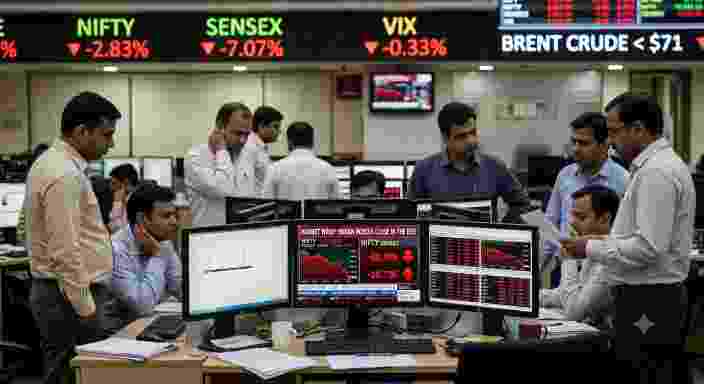
New Delhi, April 2025 — Global financial markets are navigating an unprecedented convergence of geopolitical flashpoints, with the resulting uncertainty compressing risk premiums and distorting traditional valuation frameworks. The phenomenon, characterised by market participants as operating within a persistent “fog of war,” has pushed the VIX volatility index to elevated levels not sustained since the 2022 energy crisis, while sovereign bond spreads in emerging markets have widened by an average of 45 basis points since January.
What Is Driving This Elevated Uncertainty?
Multiple simultaneous conflicts and trade tensions have created overlapping risk vectors that traditional models struggle to quantify. The Russia-Ukraine conflict continues to disrupt energy and commodity flows, while renewed tensions in the Middle East threaten critical shipping lanes. Sino-American technological decoupling has accelerated, with new semiconductor restrictions announced in March 2025 adding fresh complexity to supply chain calculations. Unlike isolated geopolitical events, the current environment presents compounding uncertainties where resolution in one theatre offers limited clarity on others.
What Does This Mean for India?
India occupies a distinctive position within this turbulent landscape, benefiting from supply chain diversification flows while remaining vulnerable to energy price volatility. Foreign portfolio investors have rotated approximately $4.2 billion into Indian equities during Q1 2025, partly reflecting India’s relative insulation from direct conflict exposure. The Reserve Bank of India has accumulated foreign exchange reserves exceeding $670 billion, providing substantial buffer against capital flight scenarios. Indian manufacturing sectors aligned with “China-plus-one” strategies—electronics, pharmaceuticals, textiles—continue attracting enhanced foreign direct investment commitments.
How Does This Compare Globally?
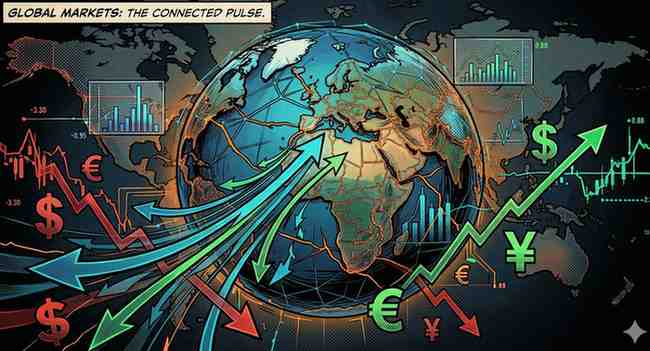
Emerging markets with direct geopolitical exposure have experienced capital outflows averaging 2.3% of GDP, compared to inflows of 0.8% for perceived neutral economies. European markets face the dual challenge of proximity to the Ukraine conflict and energy security concerns, with the Euro Stoxx 50 underperforming the S&P 500 by 340 basis points year-to-date. Safe-haven currencies including the Swiss franc and Japanese yen have appreciated 6-8% against a basket of emerging market currencies since October 2024.
- Global defence spending reached $2.7 trillion in 2024, the highest inflation-adjusted figure since Cold War peaks
- Trade policy uncertainty indices currently exceed levels recorded during the 2018-2019 tariff escalations
- Institutional investors have increased cash allocations to 7.2% of portfolios, highest since March 2020
- Gold prices have surged 18% year-to-date, reflecting flight-to-safety dynamics
- Shipping insurance premiums for Red Sea transit have increased 340% since November 2024
What Should Investors Watch?
Currency markets offer the most immediate signals of shifting risk sentiment, with USD/INR movements providing real-time reads on India-specific capital flows. Credit default swap spreads on sovereign debt serve as leading indicators of perceived country risk deterioration. Energy price trajectories remain critical for import-dependent economies like India, where every $10 per barrel increase in crude prices adds approximately 0.4% to the current account deficit.
Analyst’s View
The current geopolitical fog represents a structural rather than cyclical shift in global risk architecture. Investors should anticipate sustained volatility premiums across asset classes for at least 18-24 months, regardless of individual conflict resolutions. India’s relative positioning offers tactical advantages, but policymakers must resist complacency—the rupee’s stability depends heavily on continued foreign exchange reserve adequacy and credible inflation management. The critical variable to monitor remains the pace of global monetary policy divergence, which will determine whether emerging market assets retain their appeal amid competing safe-haven demand.