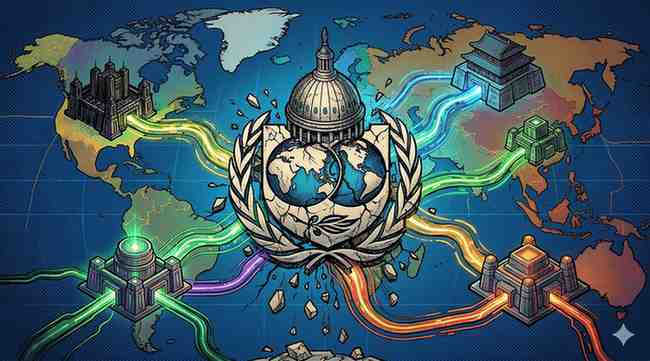
Distributed Sovereignty and Multi-Polar Power Blocs: What the Shift Away from Centralised Global Governance Means for Nation-States
- admin
- April 9, 2026
- Uncategorized
- 0 Comments
The traditional Westphalian model of centralised state sovereignty is fragmenting into networked “sovereign ecosystems” where authority distributes across regional blocs, corporate actors, and digital governance frameworks. This structural rewiring of global order challenges India’s strategic positioning as it navigates between maintaining autonomous decision-making and participating in emerging multi-stakeholder power arrangements.
New Delhi, April 2026 — The concept of distributed authority in international relations has moved from academic discourse to operational reality, with major powers increasingly building parallel institutional frameworks that bypass legacy multilateral bodies. The emergence of sovereign ecosystems — interconnected networks of states, corporations, and non-state actors sharing governance functions — represents the most significant reorganisation of global power architecture since the post-1945 settlement.
What Is Driving the Shift Toward Distributed Sovereignty?
Three structural forces are accelerating the fragmentation of centralised global governance. Digital infrastructure has created new domains where territorial sovereignty proves difficult to enforce, pushing states toward collaborative oversight models. Supply chain disruptions since 2020 have incentivised regional bloc formation, with states pooling sovereignty to secure critical inputs. The weaponisation of economic interdependence — through sanctions, export controls, and financial exclusion — has prompted middle powers to construct alternative systems that reduce vulnerability to unilateral coercion by dominant actors.
What Does This Mean for India’s Strategic Autonomy?
India’s longstanding commitment to strategic autonomy faces a definitional challenge in an era of distributed authority. New Delhi must now calibrate participation across multiple overlapping ecosystems — the Quad security architecture, BRICS financial mechanisms, bilateral digital partnerships, and emerging plurilateral trade arrangements. The Indian government’s multi-alignment approach positions it as a potential bridge node across competing ecosystems, though this requires sophisticated institutional capacity to manage contradictory obligations. India’s Digital Public Infrastructure exports represent an early model of ecosystem leadership without territorial expansion.
How Does This Compare to Previous Global Order Transitions?
The current transition differs fundamentally from the Cold War’s bipolar structure or the brief unipolar moment of the 1990s. Unlike previous shifts involving clear hegemonic succession, distributed authority creates polycentric systems without a single ordering power. The 1648 Peace of Westphalia established sovereign equality among European states; the emerging order introduces sovereign inequality within ecosystems, where anchor states exercise asymmetric influence over junior partners. Historical parallels to pre-Westphalian overlapping jurisdictions prove more instructive than twentieth-century precedents.
- BRICS expansion in 2024 added six members, creating an ecosystem representing 46% of global population and 37% of GDP at purchasing power parity
- Cross-border data governance arrangements now cover 78 countries through various bilateral and plurilateral frameworks outside WTO structures
- Regional payment systems bypassing SWIFT processed an estimated $420 billion in transactions during 2025
- India participates in 14 distinct minilateral groupings with overlapping but non-identical membership
- Corporate actors including technology platforms now exercise regulatory functions affecting 4.5 billion users across sovereign jurisdictions
What Should Policymakers and Investors Watch?
Institutional investors must map portfolio exposure across competing ecosystem boundaries, as regulatory divergence creates new compliance costs and market access risks. Multinational corporations face strategic choices about ecosystem alignment that may foreclose future market opportunities. Policymakers should monitor anchor state behaviour within ecosystems for early indicators of norm consolidation or fragmentation. Currency arrangements within sovereign ecosystems merit particular attention as potential challenges to dollar hegemony accelerate.
Analyst’s View
The distributed authority framework offers India significant opportunities but demands institutional innovation to exploit them. New Delhi’s capacity to serve as an ecosystem connector — rather than a peripheral member of competing blocs — depends on accelerating domestic reforms that enhance its value proposition to potential partners. The critical metric over the next eighteen months is whether India can establish anchor-state status within at least one major ecosystem while maintaining meaningful participation across others. Watch for Indian initiatives in digital governance standard-setting and critical minerals supply chain coordination as leading indicators of strategic intent.