Latin America’s Strategic Pivot: How U.S.-China Competition Is Reshaping Hemispheric Alliances
- admin
- April 9, 2026
- Uncategorized
- 0 Comments
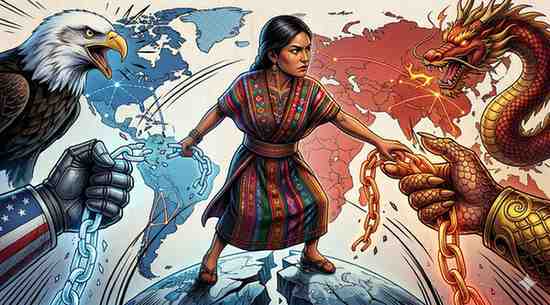
The intensifying U.S.-China rivalry is fundamentally restructuring Latin America’s economic and strategic alignments, forcing regional governments to navigate between Washington’s security imperatives and Beijing’s infrastructure investments. This triangular geopolitical dynamic presents both opportunities and risks for emerging economies, including India, seeking to diversify trade partnerships and supply chain networks in the Western Hemisphere.
New Delhi, April 2026 — China’s trade with Latin America surpassed $450 billion in 2023, representing a fifteen-fold increase since 2000 and positioning Beijing as the top trading partner for Brazil, Chile, and Peru. The Vivekananda International Foundation’s latest analysis examines how this economic penetration, coupled with Washington’s renewed hemispheric assertiveness under successive administrations, is compelling Latin American nations to adopt increasingly sophisticated multi-alignment strategies.
What Is Driving the Triangular Reconfiguration?
China’s Belt and Road Initiative has extended deep into Latin America, with 22 countries signing cooperation agreements since 2017. Beijing’s investments span critical infrastructure—ports in Peru, 5G networks in Brazil, and lithium extraction in Argentina and Chile. Washington has responded by reviving Monroe Doctrine-era rhetoric while offering alternatives through the Americas Partnership for Economic Prosperity and the Development Finance Corporation. Latin American governments, historically wary of great power interference, are leveraging this competition to extract maximum concessions from both sides.
What Does This Mean for India?
India’s strategic planners are closely monitoring Latin America’s reconfiguration as a template for managing great power competition in the Indo-Pacific. New Delhi’s bilateral trade with Latin America reached $50 billion in 2024, concentrated in petroleum imports from Brazil and pharmaceutical exports across the region. The triangular dynamic opens space for India to position itself as a non-aligned alternative partner, particularly in technology transfer and generic medicine supply chains. Indian IT companies and pharmaceutical manufacturers could benefit from Latin American governments seeking to reduce dependence on both American and Chinese suppliers.
How Does This Compare to Other Regions?
Latin America’s triangular positioning mirrors similar dynamics unfolding in Southeast Asia and Africa, though with distinct characteristics. Latin American nations possess greater institutional capacity and democratic traditions than many African states navigating Chinese investment. The region’s geographic proximity to the United States creates security constraints absent in ASEAN countries. Latin America’s commodity wealth—particularly in critical minerals essential for energy transition—provides leverage that smaller nations in other regions lack.
- China invested $173 billion in Latin America between 2005 and 2023, primarily in extractive industries and infrastructure
- The United States remains the largest foreign direct investor in Latin America with $1.1 trillion in cumulative stock
- Brazil, Mexico, and Argentina collectively hold 60% of the world’s lithium reserves critical for battery production
- Chinese state banks have extended over $138 billion in loans to Latin American governments since 2005
- India-Latin America trade grew 28% year-on-year in 2024, though starting from a low base
What Should Investors Watch?
Critical mineral supply chains represent the highest-stakes arena for triangular competition. Argentina’s lithium triangle, Brazil’s rare earth deposits, and Chile’s copper reserves are becoming focal points for U.S.-China contestation. Investors should monitor how Latin American governments structure concession agreements and whether they mandate local processing requirements that could disrupt global supply chains. Currency volatility in commodity-dependent economies will likely increase as great power competition intensifies.
Analyst’s View
Latin America’s triangular geopolitics will intensify through 2027 as both Washington and Beijing escalate economic statecraft ahead of critical elections across the region. The most significant variable is whether Latin American governments can maintain genuine strategic autonomy or whether economic dependencies will ultimately constrain their choices. India should accelerate diplomatic engagement with Brasília, Mexico City, and Buenos Aires to establish alternative partnerships before the U.S.-China binary fully crystallises. The window for middle powers to shape Latin America’s emerging order is narrowing rapidly.