Why RBI’s Decision to Hold Rates at 6.5% Reflects Confidence in India’s 6.9% Growth Trajectory
- admin
- April 9, 2026
- Uncategorized
- 0 Comments
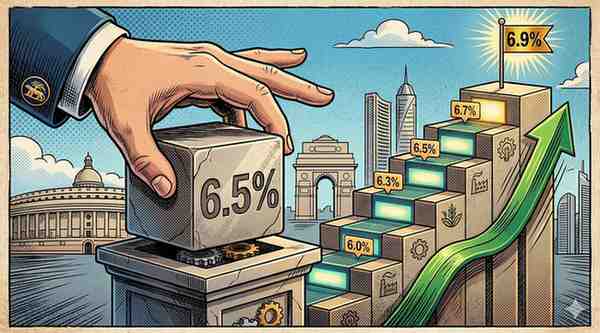
The Reserve Bank of India has maintained the repo rate at 6.5% while projecting real GDP growth at 6.9% for the current fiscal year, signalling comfort with the current inflation-growth balance. RBI’s rate pause suggests the central bank sees no immediate need for monetary stimulus despite global economic headwinds, prioritising price stability while India remains the fastest-growing major economy.
New Delhi, April 2025 — The RBI’s Monetary Policy Committee unanimously voted to keep the benchmark repo rate unchanged at 6.5%, marking a continuation of the pause that began in February 2023 after six consecutive rate hikes totalling 250 basis points.
What Is Driving RBI’s Rate Decision?
RBI Governor’s announcement reflects a calibrated approach where inflation management takes precedence over growth stimulation through cheaper credit. Consumer price inflation has moderated but remains susceptible to food price volatility, particularly in vegetables and pulses, which constitute a significant portion of India’s consumption basket. The central bank’s 4% inflation target with a 2% tolerance band continues to guide policy, with current readings within acceptable range but requiring vigilance. Global commodity prices, particularly crude oil, remain a wildcard that could disrupt India’s inflation trajectory given the country imports over 85% of its petroleum requirements.
What Does This Mean for India’s Economy?
The 6.9% GDP growth projection positions India as the world’s fastest-growing major economy, outpacing China’s anticipated 4.5-5% expansion. Indian businesses will continue facing borrowing costs at current levels, which may constrain capital expenditure plans for rate-sensitive sectors including real estate, automobiles, and infrastructure. Consumers carrying floating-rate home loans and personal credit will see no immediate relief on EMI payments, though stability provides planning certainty. The projection suggests RBI expects domestic consumption, government capital spending, and services exports to sustain momentum through the fiscal year.
How Does This Compare Globally?
RBI’s stance contrasts sharply with the US Federal Reserve, which has signalled potential rate cuts in 2025 after maintaining restrictive policy through 2024. The European Central Bank has already commenced its easing cycle, while Japan’s central bank remains an outlier with its gradual exit from negative rates. India’s decision to hold reflects its unique position — managing higher structural inflation than developed economies while maintaining growth rates that dwarf Western counterparts. The interest rate differential with the US, currently around 100-125 basis points, continues to influence foreign portfolio flows into Indian debt markets.
- Repo rate unchanged at 6.5% — held at this level since February 2023
- Real GDP growth projected at 6.9% for FY2025-26
- India’s retail inflation target remains 4% with ±2% tolerance band
- Cumulative rate hikes of 250 basis points occurred between May 2022 and February 2023
- Foreign exchange reserves provide approximately 11 months of import cover
What Should Investors Watch?
Market participants should monitor monsoon progression closely, as agricultural output directly impacts food inflation and rural consumption patterns. The trajectory of US Federal Reserve policy will influence rupee stability and foreign institutional investor behaviour in Indian equities and bonds. RBI’s liquidity management operations, including variable rate repo auctions and open market operations, will signal near-term policy intentions more clearly than headline rate decisions.
Analyst’s View
RBI’s posture suggests rate cuts remain unlikely before the third quarter of FY2025-26, contingent on sustained inflation moderation and global rate trajectories. The 6.9% growth forecast appears achievable given India’s structural advantages — favourable demographics, manufacturing incentives under PLI schemes, and expanding digital infrastructure. Investors should position for a prolonged rate plateau rather than imminent easing, while monitoring crude oil prices above $85 per barrel as the primary risk to this otherwise constructive outlook. The central bank has demonstrated it will not sacrifice hard-won inflation credibility for marginal growth gains.