India’s Strategic Autonomy Doctrine Evolves From Non-Alignment to Active Multi-Engagement
- admin
- April 8, 2026
- Uncategorized
- 0 Comments
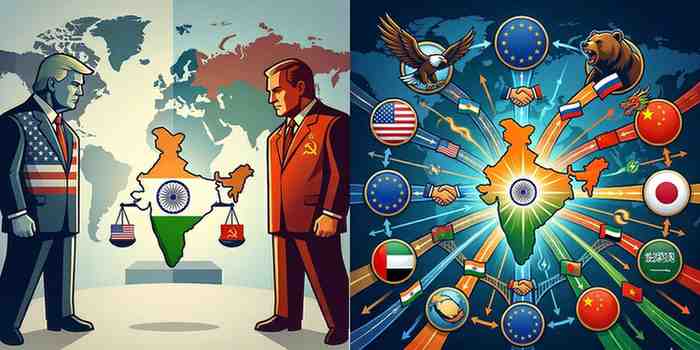
India is fundamentally redefining its strategic autonomy doctrine, shifting from passive non-alignment toward proactive multi-directional engagement with competing global powers. This evolution reflects New Delhi’s recognition that maximising strategic leverage requires simultaneous partnerships rather than equidistant detachment from major blocs.
New Delhi, April 2026 — India’s foreign policy establishment is quietly operationalising a conceptual shift that moves beyond the Cold War-era framing of non-alignment toward what strategists now term “freedom to engage” — a doctrine that prioritises transactional flexibility and issue-based partnerships across geopolitical fault lines. The NatStrat analysis underscores how this recalibration positions India to extract maximum concessions from Washington, Moscow, and Beijing without formal alliance commitments.
What Is Driving This Doctrinal Shift?
India’s strategic recalculation stems from the collapse of the post-1991 unipolar order and the emergence of a fragmented multipolar system where rigid bloc alignments carry significant opportunity costs. The Russia-Ukraine conflict exposed the limitations of Western-centric frameworks, as India maintained energy imports from Moscow while deepening defence ties with Washington. China’s aggressive posture along the Line of Actual Control since 2020 has simultaneously accelerated India’s participation in the Quad while New Delhi continues engaging Beijing through BRICS and the Shanghai Cooperation Organisation.
How Does This Compare to Traditional Non-Alignment?
Traditional non-alignment, institutionalised through the Non-Aligned Movement from 1961, emphasised equidistance and moral positioning during superpower competition. India’s contemporary approach abandons equidistance for strategic promiscuity — engaging deeply with multiple powers based on sectoral interests rather than ideological affinity. The distinction is operational rather than rhetorical: non-alignment sought to avoid entanglement, while freedom to engage actively courts multiple entanglements to maximise bargaining leverage.
What Does This Mean for India’s Global Partnerships?
India’s multi-engagement doctrine creates asymmetric dependencies that benefit New Delhi in bilateral negotiations. The United States requires Indian participation in Indo-Pacific containment strategies, giving Delhi leverage on technology transfers and immigration policy. Russia depends on Indian defence purchases to sustain its military-industrial base amid Western sanctions. Gulf states seek Indian labour and strategic partnerships, offering energy security and remittance flows in return.
- India maintained $60 billion in annual trade with Russia through 2024-25 despite Western pressure for sanctions alignment
- Quad naval exercises have expanded from 2 in 2020 to 7 annually by 2025, with India hosting 3 multilateral drills
- India-China bilateral trade reached $118 billion in 2024, even as 60,000 troops remain deployed along disputed borders
- Defence procurement split stands at approximately 55% Russian-origin, 25% Western, and 20% indigenous systems
- India holds simultaneous membership in BRICS+, SCO, Quad, and I2U2, the only major power with this configuration
What Should Investors and Policymakers Watch?
The sustainability of multi-engagement depends on India’s ability to avoid scenarios requiring binary choices between major powers. Taiwan contingencies represent the most acute stress test — American expectations of Indian support would clash directly with economic dependencies on Chinese manufacturing inputs. Energy security during any Gulf disruption would similarly test the doctrine’s limits, as India imports 85% of crude oil requirements. Domestic political pressures could also constrain flexibility if nationalist sentiment demands harder positioning against China or Pakistan.
Analyst’s View
India’s freedom to engage doctrine represents sophisticated adaptation to multipolar disorder rather than strategic drift or opportunism. The approach carries inherent contradictions — particularly the assumption that major powers will indefinitely tolerate New Delhi’s refusal to commit. Washington’s patience may narrow as US-China competition intensifies, while Beijing could weaponise economic interdependencies during border crises. The next 18 months will reveal whether India can institutionalise multi-engagement as durable grand strategy or whether external pressure forces clearer alignment choices. Monitor closely the outcomes of the upcoming defence procurement cycle and any shifts in critical minerals sourcing as leading indicators.