India’s FDI Policy Reset: Why New Delhi Is Quietly Lifting Barriers on Chinese Investment
- admin
- April 7, 2026
- Uncategorized
- 0 Comments
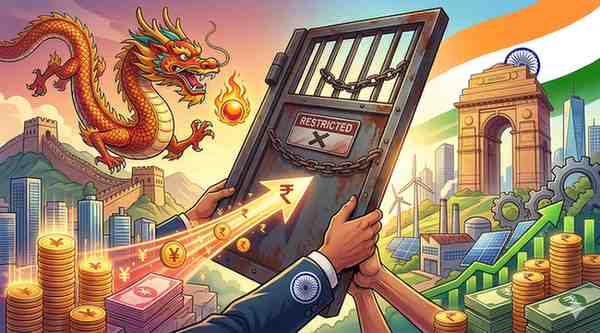
India is reversing its 2020-era restrictions on Chinese foreign direct investment, signalling a pragmatic recalibration of economic priorities over geopolitical posturing. The policy shift reflects New Delhi’s recognition that decoupling from Chinese capital and technology has imposed measurable costs on India’s manufacturing ambitions and supply chain resilience.
New Delhi, April 2025 — India’s decision to reopen investment channels with China marks the most significant bilateral economic policy shift since the Galwan Valley clash triggered sweeping restrictions nearly five years ago. The Commerce Ministry’s revised FDI framework will reportedly ease the mandatory security screening for Chinese investments in non-strategic sectors, a tacit acknowledgment that blanket restrictions have hindered India’s electronics manufacturing and renewable energy targets.
What Is Driving This Policy Reversal?
India’s manufacturing sector has struggled to attract the scale of investment needed to compete with Vietnam and Indonesia as China-plus-one destinations. Chinese firms control critical segments of global supply chains in electronics, solar panels, and electric vehicle batteries — sectors where India has set ambitious production-linked incentive targets. The previous approval-based regime created bureaucratic delays that pushed several Chinese component manufacturers toward Southeast Asian alternatives. New Delhi’s calculus now prioritises industrial capacity over security absolutism in clearly demarcated non-sensitive sectors.
What Does This Mean for India’s Manufacturing Ambitions?
India’s electronics manufacturing output reached $115 billion in FY24, but domestic value addition remains below 20 percent due to import dependence on Chinese components. Apple’s contract manufacturers in Tamil Nadu and Karnataka have repeatedly flagged supply chain vulnerabilities stemming from restricted Chinese supplier access. The policy reset could accelerate localisation in smartphone components, printed circuit boards, and display modules. India’s $10 billion semiconductor mission particularly requires Chinese-origin speciality chemicals and equipment that faced procurement hurdles under existing norms.
How Does This Compare to India’s 2020 Restrictions?
The April 2020 Press Note 3 mandated government approval for all investments from countries sharing land borders with India — a provision explicitly targeting Chinese capital. That framework effectively froze over $2 billion in pending Chinese investments and triggered retaliatory informal barriers from Beijing. The last comparable policy liberalisation occurred in 2019 when India opened single-brand retail to 100 percent FDI. This revision does not eliminate scrutiny but creates a tiered system distinguishing strategic sectors from commercial manufacturing.
- Chinese FDI into India fell from $163 million in 2019-20 to under $20 million annually post-restrictions
- Over 150 investment proposals from Chinese entities remain pending with the Home Ministry
- India’s solar module imports from China exceeded $7 billion in 2024 despite domestic PLI schemes
- Vietnam attracted $23 billion in Chinese manufacturing investment between 2020-24 during India’s restriction period
- India-China bilateral trade hit $118 billion in 2024, with India’s deficit exceeding $85 billion
What Should Investors and Businesses Watch?
The implementation mechanics will determine whether this represents genuine liberalisation or cosmetic adjustment. Investors should monitor the revised negative list specifying which sectors remain under mandatory screening. The timeline for clearing the backlog of pending Chinese applications will signal bureaucratic intent. Industry associations in electronics and renewables are expected to push for expedited approvals before the festive manufacturing season.
Analyst’s View
India’s FDI policy reset represents pragmatism prevailing over ideological rigidity, but execution risks remain substantial. The political optics of welcoming Chinese capital while border tensions persist will require careful domestic messaging. New Delhi is betting that economic competitiveness demands Chinese participation in non-strategic manufacturing — a wager that neighbouring economies validated years ago. The next 90 days will reveal whether this is genuine industrial policy or pre-election signalling. Fund managers should position for potential inflows into electronics manufacturing and solar EPC contractors while remaining attentive to any reversal triggered by border incidents or political backlash.