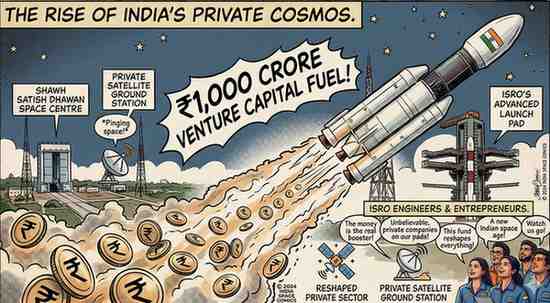
India’s Antariksh Venture Capital Fund: How ₹1,000 Crore Will Reshape the Private Space Sector
- admin
- April 3, 2026
- Uncategorized
- 0 Comments
The Antariksh Venture Capital Fund is India’s first dedicated government-backed fund for private space startups, designed to channel institutional capital into a sector that has attracted limited early-stage funding despite policy liberalisation since 2020. The ₹1,000 crore fund, managed by the Indian National Space Promotion and Authorisation Centre (IN-SPACe), aims to de-risk private investment and accelerate India’s share of the global space economy from under 2% to 10% by 2030.
New Delhi, April 2025 — The Union government’s announcement of the Antariksh Venture Capital Fund marks the most significant financial intervention in India’s space sector since the opening of satellite launches to private players in 2020. The fund addresses a critical gap: despite hosting over 200 space-tech startups, India’s private space sector raised only $124 million in 2023, compared to $8.3 billion flowing into US space ventures during the same period.
What Is the Strategic Objective Behind the Fund?
The Antariksh Fund is designed to serve as anchor capital that attracts larger institutional investors who have remained cautious about space ventures due to long gestation periods and high capital requirements. Government participation reduces perceived risk for domestic and foreign limited partners considering exposure to Indian space-tech. The fund will prioritise startups working on satellite manufacturing, launch vehicle components, space situational awareness, and downstream applications like remote sensing analytics. This targeted approach reflects lessons from the success of the SIDBI Fund of Funds, which catalysed India’s broader startup ecosystem after 2016.
How Does This Compare to Global Space Investment Models?
The United States Space Force and NASA have long operated procurement-based funding models that guarantee revenue to private players like SpaceX and Rocket Lab. China’s space investment flows primarily through state-owned enterprises and provincial government funds, with Jiuquan and Wenchang emerging as dedicated space-industrial clusters. India’s fund model is closer to the European Space Agency’s InCubed programme, which co-invests in commercial ventures while retaining strategic oversight. The ₹1,000 crore allocation, while modest by global standards, represents a 15-fold increase over IN-SPACe’s previous annual disbursement capacity.
What Does This Mean for Indian Space Startups?
Startups such as Skyroot Aerospace, Agnikul Cosmos, and Pixxel have demonstrated technical capability but face persistent Series B and Series C funding constraints. The Antariksh Fund will provide growth-stage capital that bridges the gap between proof-of-concept and commercial deployment. Critically, fund participation will likely come with technology transfer clauses and ISRO collaboration frameworks, creating a dual benefit of capital access and institutional knowledge. The fund’s investment committee structure, which includes representatives from ISRO, DRDO, and the Department of Space, ensures alignment with national security priorities.
- Fund corpus: ₹1,000 crore (approximately $120 million) with provision for expansion
- Managed by IN-SPACe, India’s autonomous space regulatory and promotional body established in 2020
- Target: 40-50 investments across seed, Series A, and Series B stages over five years
- Sector focus: launch vehicles, satellite manufacturing, ground systems, and space applications
- Expected leverage ratio: 3:1 private capital mobilisation against government anchor investment
What Should Investors and Policymakers Watch?
The fund’s governance structure will determine whether it operates with venture-style agility or succumbs to bureaucratic procurement timelines. Disbursement velocity in the first 18 months will signal institutional capacity. Policymakers must also address the regulatory vacuum around spectrum allocation and orbital debris liability that continues to create uncertainty for investors. The absence of a dedicated space law—promised since 2017 but still pending—remains a structural impediment that the fund alone cannot resolve.
Analyst’s View
The Antariksh Fund represents necessary but insufficient intervention in India’s space commercialisation ambitions. Government anchor capital will improve deal flow and validate the sector for risk-averse domestic institutions, yet the fund’s modest size limits its ability to support capital-intensive launch vehicle programmes that require ₹500-800 crore per orbital attempt. The metric to watch is not deployment speed but co-investment ratios: if the fund achieves its 3:1 leverage target within three years, it will have succeeded in shifting private capital allocation toward space. Failure to do so will confirm that India’s space-tech bottleneck is regulatory and market-structural rather than purely financial.