Why India Lacks a Coherent Foreign Policy Doctrine and What Strategic Ambiguity Costs Delhi
- admin
- April 3, 2026
- Uncategorized
- 0 Comments
India continues to operate without a clearly articulated foreign policy doctrine, relying instead on case-by-case strategic pragmatism that critics argue undermines long-term geopolitical positioning. The absence of a formal rubric leaves Indian diplomacy reactive rather than anticipatory, creating uncertainty among allies and adversaries alike about Delhi’s core strategic commitments.
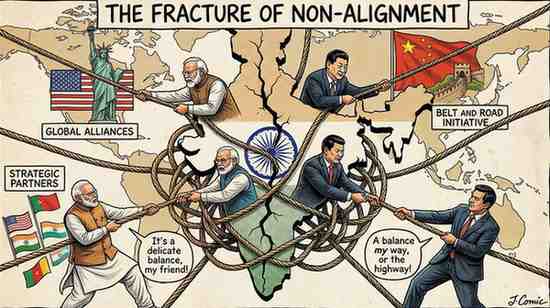
New Delhi, April 2026 — India’s foreign policy establishment faces renewed scrutiny over its reluctance to codify a grand strategic framework, even as the country navigates an increasingly fractured global order marked by US-China rivalry, ongoing tensions with Pakistan and China, and shifting alignments in the Global South. NatStrat’s latest analysis highlights a persistent structural weakness: India remains one of the few major powers without a publicly articulated doctrine guiding its international engagements.
What Is Driving the Debate Over Indian Foreign Policy Doctrine?
India’s foreign policy has historically operated on principles of non-alignment, strategic autonomy, and multi-alignment without formally institutionalising these concepts into binding doctrine. The Nehru era’s non-alignment gave way to the Indira Gandhi period’s pragmatic realism, yet no subsequent administration has produced an equivalent to America’s National Security Strategy or China’s white papers on defence and diplomacy. This absence reflects both bureaucratic inertia and a deliberate preference for flexibility, allowing Delhi to pivot between Washington and Moscow as circumstances demand.
What Does Strategic Ambiguity Cost India?
Strategic ambiguity carries measurable costs in an era demanding clarity from major powers. India’s Quad partners—the United States, Japan, and Australia—frequently express private frustration over Delhi’s reluctance to articulate red lines on Indo-Pacific security. Foreign direct investment decisions increasingly hinge on geopolitical predictability, and India’s undefined posture complicates corporate risk assessments. The 2020 Galwan Valley clash exposed how the absence of doctrinal clarity left India initially flat-footed in responding to Chinese aggression along the Line of Actual Control.
How Does India’s Approach Compare Globally?
Major powers typically publish formal strategic documents outlining threat perceptions, alliance commitments, and resource allocation priorities. The United States issues a National Security Strategy with each administration; China releases defence white papers every two years; even middle powers like Australia and Japan maintain published doctrines. India’s Ministry of External Affairs produces no equivalent public document, with the closest approximation being occasional prime ministerial speeches at forums like Shangri-La Dialogue or Raisina Dialogue. This places India in an unusual category among G20 nations—strategically consequential yet doctrinally opaque.
- India has not published a formal foreign policy doctrine since independence in 1947
- The last comprehensive defence strategy document was the 2019 Defence Planning Committee report, which remains classified
- India’s foreign ministry budget for 2025-26 stands at ₹22,154 crore, approximately 0.07% of GDP—among the lowest ratios for major economies
- Delhi maintains strategic partnerships with over 30 countries but has defence treaty obligations with none
- India abstained on 11 major UN General Assembly resolutions concerning the Russia-Ukraine conflict between 2022 and 2025
What Should Policymakers and Analysts Watch?
External Affairs Minister S. Jaishankar has articulated elements of a strategic vision through his writings and speeches, emphasising issue-based alignments over bloc politics. Whether this intellectual framework translates into institutionalised doctrine depends on political will and bureaucratic capacity. The forthcoming National Security Strategy, reportedly under preparation since 2018, remains unpublished despite multiple announcements.
Analyst’s View
India’s doctrinal vacuum represents a structural vulnerability that will become increasingly untenable as great power competition intensifies. The next 18 months offer a critical window: if Delhi fails to articulate clearer strategic priorities before potential shifts in US policy post-2026 elections, India risks being treated as a swing state rather than a pole in the emerging multipolar order. Observers should monitor whether the Modi government finally releases a National Security Strategy and whether the Quad’s institutional architecture demands more explicit Indian commitments on Taiwan Strait contingencies and South China Sea freedom of navigation.