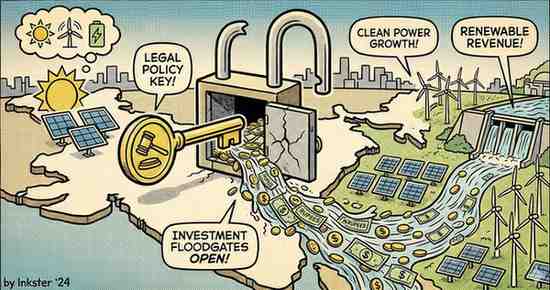
India’s Energy Law Reforms Could Unlock $50 Billion in Clean Power Investment by 2030
- admin
- April 2, 2026
- Uncategorized
- 0 Comments
India’s evolving legal framework for energy policy is creating new pathways for private investment in renewable infrastructure while addressing long-standing regulatory bottlenecks. The convergence of energy law, environmental mandates, and industrial policy represents a structural shift that could reshape India’s power sector economics over the next decade.
New Delhi, April 2026 — The intersection of legal frameworks and energy policy has emerged as the critical determinant of India’s clean energy transition, with regulatory clarity now directly influencing capital allocation decisions worth tens of billions of dollars annually. Industry participants and legal experts are increasingly recognising that India’s energy future will be shaped as much in courtrooms and regulatory tribunals as in power plants and grid infrastructure.
What Is Driving the Convergence of Law and Energy Policy?
India’s power sector operates under a complex matrix of central and state regulations that has historically created uncertainty for investors and project developers. The Electricity Act of 2003 established the foundational framework, but subsequent amendments and judicial interpretations have continuously reshaped market dynamics. Recent policy initiatives including the Production Linked Incentive schemes for solar manufacturing and green hydrogen missions require sophisticated legal architectures to ensure enforceability and bankability. Contract sanctity, land acquisition disputes, and environmental clearance timelines remain the primary legal friction points affecting project viability.
What Does This Mean for India’s Energy Transition?
India’s target of 500 gigawatts of non-fossil fuel capacity by 2030 depends critically on resolving legal impediments that currently delay projects by 18-24 months on average. Power purchase agreement disputes between distribution companies and generators have historically undermined investor confidence, with outstanding dues to renewable developers exceeding ₹20,000 crore at various points. The establishment of specialised energy tribunals and expedited dispute resolution mechanisms could accelerate capital deployment significantly. State-level regulatory harmonisation remains essential, as divergent policies across major renewable markets like Gujarat, Rajasthan, and Tamil Nadu create compliance complexity.
How Does India Compare Globally on Energy Regulation?
India’s regulatory framework for energy sits between the highly liberalised European model and the state-dominated Chinese approach, offering neither complete market freedom nor centralised execution efficiency. The International Energy Agency has noted that India’s permitting timelines for renewable projects exceed those in comparable emerging markets by approximately 40 percent. Germany’s Energiewende and the United States’ Inflation Reduction Act demonstrate how legislative clarity can mobilise private capital at scale. India’s challenge lies in replicating such clarity while navigating its federal structure and legacy grid infrastructure constraints.
- India requires approximately $225 billion in energy infrastructure investment between 2025 and 2030 to meet climate commitments
- Renewable energy disputes pending before appellate tribunals exceeded 400 cases in the last fiscal year
- Average time for environmental clearance for power projects stands at 210 days versus a statutory target of 105 days
- Cross-subsidy surcharges vary from 15% to 45% across states, affecting open access viability
- Foreign direct investment in India’s power sector reached $17.8 billion cumulatively through 2025
What Should Investors and Policymakers Watch?
The pending Electricity Amendment Bill provisions regarding delicensing of distribution and direct benefit transfers for subsidies will fundamentally alter sector economics if enacted. Investors should monitor Supreme Court proceedings on renewable purchase obligation enforcement, which could establish binding precedents for state compliance. The operationalisation of the Green Credit Programme and carbon market regulations will create new legal instruments requiring careful structuring. Corporate power purchase agreements are emerging as a growth segment, but their enforceability across state boundaries remains legally untested at scale.
Analyst’s View
India’s energy transition has entered a phase where legal infrastructure matters as much as physical infrastructure. The next 18 months will prove decisive as key legislative amendments, tribunal judgments, and regulatory orders establish the rules governing trillions of rupees in capital deployment. Sophisticated market participants are building dedicated legal and regulatory intelligence capabilities, recognising that policy arbitrage opportunities will increasingly determine competitive advantage. The fundamental question is whether India’s legal system can evolve at the pace its energy ambitions demand — current evidence suggests progress is real but unevenly distributed across jurisdictions and technologies.