Dollar Weakness in Early 2025 Challenges Reserve Currency Assumptions and Reshapes Emerging Market Calculus
- admin
- April 2, 2026
- Uncategorized
- 0 Comments
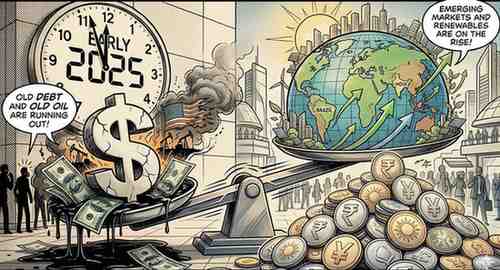
The US dollar’s underperformance in early 2025 has defied market expectations of continued strength, raising fundamental questions about the currency’s trajectory amid shifting Federal Reserve policy signals and global capital reallocation. This dollar weakness carries significant implications for emerging markets like India, potentially easing import costs and foreign debt servicing burdens while complicating export competitiveness calculations.
New Delhi, April 2025 — The greenback’s failure to sustain its 2024 gains marks the first significant dollar correction since the aggressive Federal Reserve tightening cycle began in 2022, with the DXY index retreating nearly 4% from its October 2024 highs despite persistent inflation concerns in the United States.
What Is Driving the Dollar’s Disappointing Performance?
The Federal Reserve’s increasingly cautious stance on further rate hikes has eroded the yield differential advantage that propelled dollar strength throughout 2023 and 2024. Global investors have begun rotating capital toward European and Asian markets where growth trajectories appear more favourable relative to valuations. The US fiscal deficit, now exceeding 6% of GDP, has renewed concerns about long-term dollar sustainability that institutional investors cannot ignore. Geopolitical diversification efforts by central banks, particularly in Asia and the Middle East, continue to gradually reduce dollar holdings in foreign exchange reserves.
What Does This Mean for India?
The Reserve Bank of India faces a complex policy recalibration as rupee appreciation pressure emerges after two years of defending against depreciation. Indian corporates holding approximately $180 billion in external commercial borrowings stand to benefit from reduced dollar-denominated servicing costs. Import-dependent sectors, particularly oil and gas where India sources 85% of its crude requirements, will experience margin relief if dollar weakness persists. However, India’s IT services exporters and pharmaceutical manufacturers may face revenue compression as dollar-denominated contracts translate to fewer rupees.
How Does This Compare Globally?
The current dollar weakness echoes the 2017 correction when the greenback fell 10% despite expectations of Trump-era fiscal stimulus driving sustained strength. Emerging market currencies have responded asymmetrically, with the Brazilian real and South African rand outperforming while the Chinese yuan remains constrained by domestic economic concerns. European Central Bank officials have expressed discomfort with euro strength, suggesting potential policy responses if the EUR/USD exchange rate breaches 1.15 levels.
- The DXY dollar index has declined 3.8% from its October 2024 peak of 106.7
- Foreign central banks reduced US Treasury holdings by $127 billion in the six months ending February 2025
- The rupee has strengthened to 82.4 per dollar from 83.7 at the start of 2025
- India’s forex reserves have increased by $18 billion since January, reaching $673 billion
- Gold prices have surged 12% year-to-date as dollar alternatives gain traction
What Should Investors Watch?
Currency markets will scrutinise the Federal Reserve’s June policy meeting for signals on the rate trajectory through 2025. The US Treasury’s quarterly refunding announcements carry heightened significance given deficit financing requirements exceeding $2 trillion annually. Indian equity markets may see renewed foreign institutional investor inflows if dollar weakness persists, reversing the $14 billion outflow recorded in 2024.
Analyst’s View
The dollar’s underperformance likely represents a cyclical correction rather than structural decline, but the duration and magnitude remain uncertain. Indian policymakers should utilise this window to accelerate forex reserve accumulation and encourage corporate external debt prepayment. The RBI’s intervention strategy will prove critical — excessive rupee appreciation could undermine export competitiveness precisely when global trade conditions favour emerging market manufacturers. Investors should monitor the 81.5 rupee-dollar level as the threshold where RBI intervention intensity typically increases, while maintaining hedged positions given the elevated probability of dollar recovery in the second half of 2025.