India’s Trade Strategy Faces Critical Test as Geopolitical Realignment Reshapes Global Commerce
- admin
- April 2, 2026
- Uncategorized
- 0 Comments
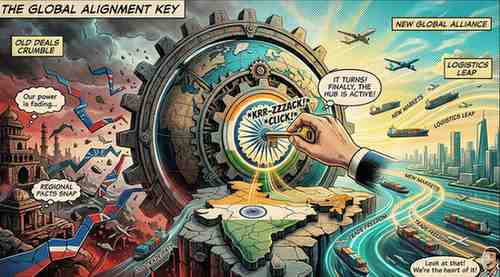
India confronts a pivotal moment in its development trajectory as intensifying great-power competition forces a fundamental reassessment of its trade and industrial policies. The country’s strategic ambiguity between Western democracies and alternative blocs is becoming increasingly untenable as global supply chains fragment along geopolitical lines.
New Delhi, April 2026 — The Hinrich Foundation’s latest analysis underscores a structural challenge that Indian policymakers can no longer defer: reconciling the nation’s developmental imperatives with a rapidly bifurcating global trading system. India’s goods exports remain stubbornly anchored at approximately 12% of GDP, compared to Vietnam’s 93% and Bangladesh’s 15%, exposing the limitations of an inward-oriented growth model in an era demanding export competitiveness.
What Is Driving India’s Strategic Reckoning?
The convergence of three forces compels this reassessment. First, the US-China technological decoupling has created both opportunity and risk for non-aligned economies seeking manufacturing diversification benefits. Second, India’s ambitious Production-Linked Incentive schemes, worth over ₹2 lakh crore, have delivered uneven results across sectors. Third, the country’s trade deficit with China widened to $85 billion in FY2024, revealing persistent dependencies that contradict self-reliance rhetoric.
What Does This Mean for India’s Development Model?
India’s traditional approach of balancing strategic autonomy with economic pragmatism faces unprecedented strain. The Make in India initiative, launched a decade ago, succeeded in mobile phone assembly but failed to create deep component ecosystems. Services exports, while robust at $340 billion annually, cannot substitute for manufacturing employment generation that India’s demographic profile demands. Policymakers must now choose between deeper Western integration and maintaining commercial flexibility with Russia and China.
How Does India Compare to Regional Competitors?
Vietnam attracted $23 billion in FDI in 2024 by decisively positioning within Western supply chains and signing comprehensive trade agreements. Bangladesh’s garment sector employs 4.4 million workers despite political instability. Indonesia leveraged its nickel reserves into downstream battery manufacturing commitments. India’s cautious approach to trade agreements—no comprehensive deal since 2011 until the UAE and Australia pacts—has cost it first-mover advantages in critical sectors.
- India’s manufacturing share of GDP has stagnated at 13-14% for two decades, below the 25% target
- The country ranks 63rd globally in logistics performance, trailing China (19th) and Vietnam (43rd)
- Tariff rates averaging 18.3% remain among the highest for major economies
- Free Trade Agreement coverage extends to only 15% of India’s total trade value
- Foreign direct investment inflows declined 16% year-on-year in FY2024 to $44.4 billion
What Should Investors and Businesses Watch?
The trajectory of India-UK and India-EU trade negotiations will signal strategic direction more clearly than domestic policy pronouncements. Sector-specific outcomes in electronics, pharmaceuticals, and green energy will determine whether India captures meaningful China-plus-one investment. State-level variations in implementation capacity increasingly matter; Tamil Nadu and Gujarat attract disproportionate manufacturing interest while other states lag substantially.
Analyst’s View
India’s window for passive gains from geopolitical realignment is closing. The next eighteen months will reveal whether New Delhi possesses the institutional capacity and political will to execute difficult trade-offs—accepting agricultural market access demands in exchange for services liberalisation, streamlining land acquisition despite electoral sensitivities, and choosing strategic partners over comfortable ambiguity. The structural reforms required are well-documented; execution remains the binding constraint. Fund managers should monitor the semiconductor incentive disbursement timeline and any movement on the stalled India-EU negotiations as leading indicators of genuine policy momentum versus continued incrementalism.