Geopolitical Shock Erases Rs 51 Lakh Crore From Indian Equities: Anatomy of a Record FII Exodus
- admin
- April 2, 2026
- Uncategorized
- 0 Comments
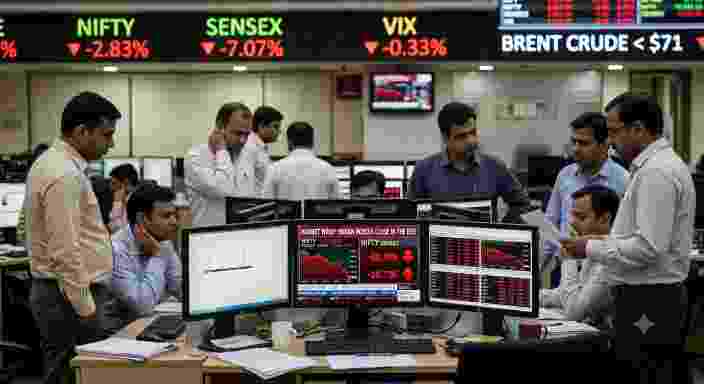
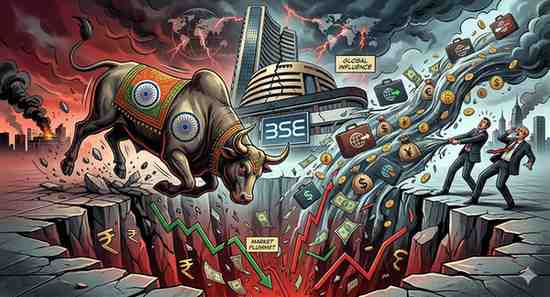
US-Iran military escalation has triggered the largest single foreign institutional investor outflow in Indian market history, with $12 billion fleeing domestic equities and benchmark indices shedding Rs 51 lakh crore in market capitalisation. The selloff represents a structural repricing of geopolitical risk premiums across emerging markets, with India’s import-dependent energy profile amplifying vulnerability.
New Delhi, May 2025 — Indian equity markets have recorded their steepest erosion of wealth since the COVID-19 crash of March 2020, as direct military confrontation between the United States and Iran sent global risk assets into freefall. The Sensex and Nifty 50 breached multiple technical support levels in a single session, with the benchmark indices declining over 4% intraday before partial recovery attempts failed to hold.
What Is Driving This Historic Selloff?
Foreign institutional investors have withdrawn a record $12 billion from Indian equities in response to the US-Iran conflict, surpassing the previous single-event outflow of $8.4 billion during the 2020 pandemic panic. The exodus reflects a classic flight-to-safety repositioning, with capital rotating toward US Treasuries, gold, and the Japanese yen. Brent crude prices spiking above $95 per barrel have compounded concerns, given India imports approximately 85% of its crude oil requirements. The rupee has simultaneously weakened past the 86-mark against the dollar, creating a dual pressure of currency depreciation and equity markdown for foreign holders.
What Does This Mean for India’s Economy?
India’s current account deficit faces immediate stress from elevated energy import bills, potentially widening from the projected 1.2% of GDP to above 2% if oil prices sustain at current levels. The Reserve Bank of India’s inflation management calculus becomes considerably more complex, as fuel price pass-through threatens to push CPI above the 6% tolerance ceiling. Corporate earnings for Q1 FY26 now carry significant downside risk, particularly for aviation, logistics, and paint sectors where crude derivatives constitute major input costs. Government fiscal arithmetic also deteriorates, as fuel subsidy expenditure may require supplementary budget allocations.
How Does This Compare to Previous Geopolitical Shocks?
The $12 billion FII outflow exceeds the cumulative withdrawals during the entire Russia-Ukraine conflict period of 2022, which totalled $10.8 billion over three months. Market capitalisation erosion of Rs 51 lakh crore represents approximately 8% of India’s GDP, a wealth destruction magnitude last witnessed during the 2008 global financial crisis. The velocity of selling distinguishes this episode from previous corrections — algorithmic trading and ETF redemption mechanics have accelerated price discovery in ways absent during earlier geopolitical events.
- FII outflows reached $12 billion — highest single-event withdrawal in Indian market history
- Market capitalisation loss of Rs 51 lakh crore equivalent to 8% of India’s GDP
- Brent crude prices surged above $95/barrel, threatening India’s current account stability
- Rupee breached 86/$ mark, compounding foreign investor losses
- Previous comparable outflow was $8.4 billion during March 2020 COVID crash
What Should Investors Watch?
Diplomatic developments in the Persian Gulf remain the primary variable determining market trajectory over the coming sessions. Any indication of conflict containment or third-party mediation could trigger sharp short-covering rallies given the extreme oversold conditions. RBI intervention in currency markets bears monitoring, as the central bank holds $620 billion in foreign exchange reserves — adequate for sustained defence if deployed strategically. Domestic institutional investors, particularly mutual funds with accumulated SIP inflows, may provide buying support at current valuations.
Analyst’s View
The market correction, while severe, creates selective entry opportunities for investors with 12-18 month horizons, particularly in domestically-oriented sectors insulated from crude volatility. Banking, telecommunications, and consumer staples present relatively defensive positioning. However, the geopolitical risk premium embedded in Indian equities may persist until conflict resolution becomes visible, suggesting volatility will remain elevated through Q2 FY26. Strategic patience rather than aggressive bottom-fishing appears prudent until oil prices stabilise below $85 per barrel and FII selling exhaustion becomes evident in daily flow data.