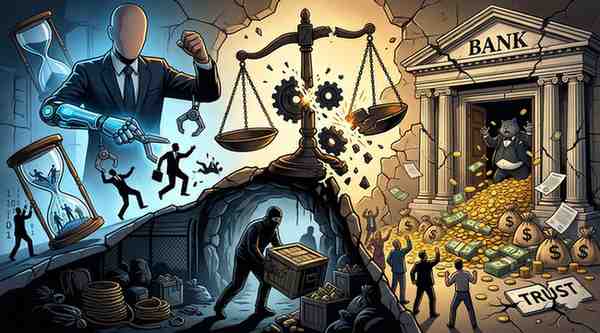
The Accountability Crisis: Smuggling, AI Cuts, and Banking Scandals
- Editor
- March 23, 2026
- Artifical Intelligance, Banking & Finance, Business, Companies & Industry, Global Business
- 0 Comments
NEW YORK / LONDON / MUMBAI — A wave of corporate instability has hit the global markets this week, exposing deep cracks in the “growth-at-all-costs” philosophy. From high-tech smuggling rings in Silicon Valley to mass AI-driven layoffs in London and internal fraud in Mumbai, the corporate world is facing a harsh regulatory and operational reset.
What many viewed as a period of unstoppable innovation is now being scrutinized as a era of significant oversight failures and ethical shortcuts.
The $2.5 Billion AI Shadow Pipeline
Shares of Super Micro Computer plummeted by 12–14% following a shock federal indictment. The company’s co-founder has been arrested on allegations of orchestrating a massive smuggling operation to funnel high-end AI chips into China, bypassing strict U.S. national security restrictions.
- The Operation: Federal prosecutors allege that over $2.5 billion worth of Nvidia AI chips were rerouted through front companies to evade export controls.
- National Security Impact: These chips are the “crown jewels” of modern computing, essential for training large-scale military and surveillance AI.
- The Market Reaction: The arrest has sent ripples through the semiconductor industry, with investors fearing that further “chip-leak” investigations could trigger even tighter restrictions on AI hardware exports.
HSBC: The 20,000-Job AI Reckoning
In a move that signals the end of traditional “back-office” banking, HSBC has announced a plan to eliminate roughly 20,000 roles globally. The layoffs target “non-client facing” positions—the administrative engine that has powered the bank for decades.
- The AI Shift: This isn’t just a cost-cutting measure; it is a total pivot. HSBC is replacing these human roles with advanced AI and automation systems capable of handling data entry, compliance checks, and routine reporting.
- The Human Cost: Employees in service centers across India, the Philippines, and the UK face an uncertain future as the bank bets its efficiency on algorithms over human labor.
HDFC Bank: The “Mis-selling” Cleanup
Domestic banking giant HDFC Bank is facing internal turmoil after terminating three senior executives for what has been described as a predatory sales scheme involving retail bonds.
- The Illusion of Safety: The executives allegedly marketed high-risk bonds to retail investors as “fixed maturity products”—a term usually associated with low-risk, predictable returns.
- The Reality: These products held significant underlying risks that were reportedly hidden from investors to meet aggressive sales targets.
- The Fallout: The terminations are a desperate attempt by the bank to restore trust, but the incident has raised questions about “target-driven culture” in Indian banking that often prioritizes commissions over client welfare.
Crypto Fraud: The “CoinDCX Pro” Trap
The founders of CoinDCX have been questioned regarding a sophisticated ₹71.6 lakh scam that exploited the brand’s reputation to drain investor wallets.
- The Fake Platform: Scammers created a mirror website titled “CoinDCX Pro,” luring users with promises of 10–12% guaranteed returns—a classic hallmark of a Ponzi scheme.
- The Investigation: While the official exchange has distanced itself from the fraud, the incident highlights the extreme vulnerability of retail investors in the largely unregulated crypto space. Even as platforms grow, the “wild west” of fake clones and phishing sites continues to thrive in their shadow.
Sector Disruption at a Glance
| Entity | Incident Type | Primary Impact |
| Super Micro | Smuggling / Geopolitics | $2.5B chip leak; Stock down 14% |
| HSBC | AI Automation | 20,000 “non-client” jobs cut |
| HDFC Bank | Internal Fraud | Senior execs fired; retail trust hit |
| CoinDCX | Brand Mimicry | ₹71.6 Lakh retail scam |
Bottom Line
From the smuggling of physical chips to the digital automation of jobs and the mis-selling of financial products, 2026 is becoming a year where the “masks” of corporate giants are being pulled back. Whether through AI or illegal trade, the pursuit of profit is increasingly colliding with the law, leaving employees and retail investors to pick up the pieces.