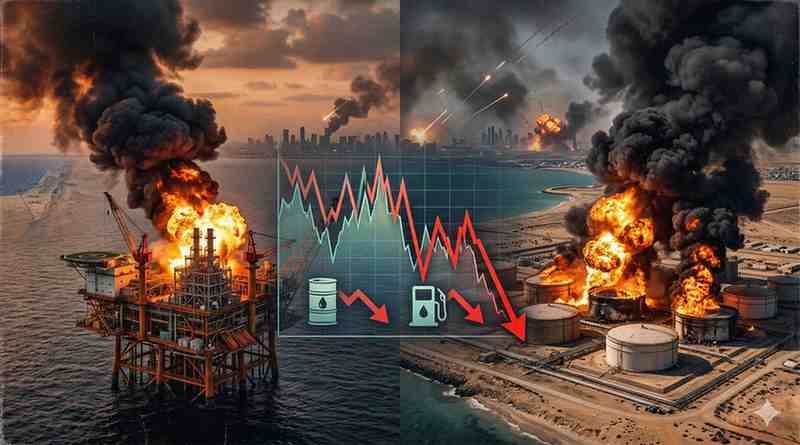
West Asia War Day 20: Energy Markets in Turmoil as Israel and Iran Strike Gas Infrastructure
- Editor
- March 20, 2026
- Uncategorized
- 0 Comments
New Delhi, March 20, 2026 — The conflict between Israel, the U.S., and Iran has entered its 20th day, evolving from a localized military engagement into a catastrophic global energy crisis. A series of retaliatory strikes on critical gas and oil infrastructure has sent Brent crude surging past $115 a barrel, while India’s aviation regulator has effectively grounded flights across most of the Middle East.
The Battle for Energy: South Pars and Qatar’s $20B Blow
The conflict reached a new level of economic warfare on Wednesday when Israel struck Iran’s South Pars gas field, the largest natural gas reserve in the world. Iran responded hours later with missile strikes targeting oil and gas facilities across Saudi Arabia, Qatar, and the UAE.
The damage to Qatar is particularly staggering. Strikes on the Ras Laffan Industrial City have knocked out 17% of the nation’s LNG export capacity. QatarEnergy CEO Saad Al-Kaabi confirmed that repairs could take up to five years, with an estimated annual revenue loss of $20 billion. The company has declared force majeure on its entire LNG output, jeopardizing long-term energy contracts with Italy, Belgium, South Korea, and China.
India Grounds Middle East Skies
In response to the escalating aerial warfare, India’s Directorate General of Civil Aviation (DGCA) issued an immediate advisory on Friday. Indian airlines are now prohibited from entering the airspace of nine West Asian nations, including Iran, Iraq, Israel, and the UAE.
- Flight Disruptions: Over 850 weekly flight frequencies have been disrupted.
- Rerouting: Long-haul carriers are now forced to navigate costly detours over the Arabian Sea, Central Asia, and Egypt.
- Strict Corridors: Limited overflights of Saudi Arabia and Oman are only permitted above 32,000 feet along specific, high-safety corridors.
Legal Victory for Vantara
Amidst the geopolitical chaos, the Supreme Court of India delivered a significant domestic ruling, dismissing a PIL against Vantara, the Ambani family’s wildlife rescue center in Jamnagar. The court rejected the plea for a fresh audit, citing a previous “clean chit” from a special investigation team. The bench notably observed that disturbing the settled living conditions of rescued animals after lawful import could itself be considered an act of cruelty.
Tragedy in Indore: EV Safety Warning
On the domestic front, a devastating fire in Indore has claimed the lives of eight family members. Authorities believe the blaze began when an electric vehicle (EV) charging point exploded outside a residential building, igniting nearby gas cylinders. Chief Minister Mohan Yadav has ordered a high-level probe, calling the incident a “serious warning” regarding EV charging safety and infrastructure standards.
Bottom Line From the literal fire in Indore to the metaphorical fire consuming the world’s energy corridors, the events of March 20 mark a turning point in regional stability. With the Strait of Hormuz effectively blocked and critical infrastructure in ruins, the global economy is now bracing for a long-term shift in energy trade and food supply chains.