Global Oil Markets in Turmoil as Trump Administration Grapples with Hormuz Crisis
- Editor
- March 13, 2026
- Automobile, Business, Defence, Economy, Global Business
- 0 Comments
Washington D.C., March 2026 — The “Operation Epic Fury” fallout has sent global oil markets into a violent tailspin. What the White House initially framed as a calculated strike to neutralise threats has rapidly morphed into a geopolitical nightmare. As the Strait of Hormuz remains choked by Iranian forces, the reality of a protracted energy crisis is setting in, revealing a massive miscalculation by the Trump administration.
The Hormuz Chokehold: A Strategic Blind Spot
For decades, the Strait of Hormuz has been the world’s most sensitive oil artery. Following recent U.S. and Israeli military strikes, Iran’s new Supreme Leader, Mojtaba Khamenei, made his international debut not with a plea for peace, but with a vow of “ruthless vengeance.”
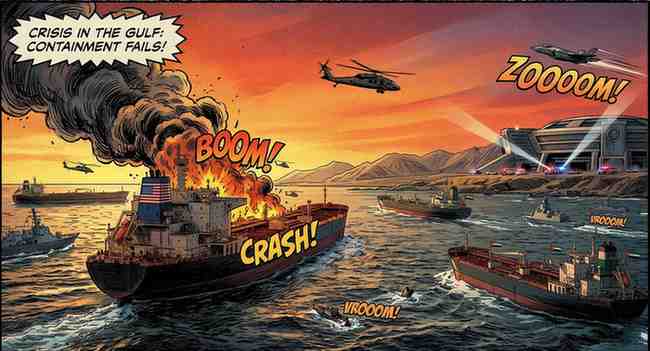
By officially shutting the Strait, Iran has effectively blocked 20% of the world’s oil supply. Reports indicate that at least 16 commercial tankers have already been targeted or seized. Insiders suggest the Trump administration genuinely believed the markets would “jump and then dip” quickly; instead, they have stayed sky-high, leaving the White House frantically scrambling for a “Plan B” that doesn’t seem to exist.
The $100 Barrel: Profit vs. Pain
As oil prices surged past the $100 mark, President Trump remained characteristically defiant. In his March 12th remarks, he pivoted to an “America First” economic defense:
“The United States is the largest oil producer in the world… so when oil prices go up, we make a lot of money.”
However, this “silver lining” ignores the staggering cost of living increases hitting American households. While the U.S. may produce oil, the global economy—and the American consumer—is reeling from the inflationary pressure. Critics argue the President is prioritising a “nuclear-free Iran” at the expense of global financial stability.
The Astronomical Cost of “Epic Fury”
The financial scale of this conflict is perhaps the most shocking revelation. Data leaked following a closed-door briefing paints a grim picture of American resource depletion:
- Initial 48 Hours: The U.S. burned through $5.6 billion in advanced munitions.
- First Week: Spending on heavy weapons and deployments topped $11.3 billion.
- The 100-Hour Mark: Strategic think tanks estimate the first 100 hours of “Operation Epic Fury” cost a total of $37.7 billion.
At a burn rate of $891 million per day, lawmakers are raising alarms that the U.S. is “burning its house down to keep the neighborhood warm.”
Bottom Line
The Trump-Netanyahu strategy was built on the assumption that Iran would fold under “maximum pressure.” Instead, the closure of the Strait of Hormuz has turned the Middle East into a financial black hole. With no coherent plan to reopen the waters and munitions running low, the “Epic Fury” may end up being an epic drain on the American taxpayer.