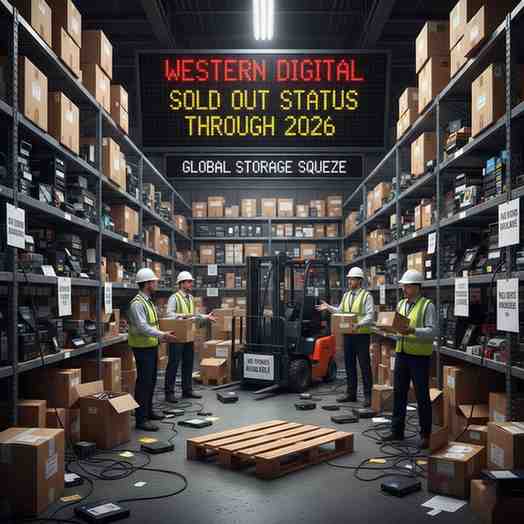
The Great Storage Squeeze: Western Digital Reports “Sold Out” Status Through 2026
- Editor
- February 18, 2026
- Business, Business Trends, Companies & Industry, Global Business, Markets
- 0 Comments
San Jose, February 2026 — In a move that has sent shockwaves through the global hardware market, Western Digital (WD) has announced that its entire hard drive production capacity for the calendar year 2026 is already fully booked.
During a recent earnings call, CEO Irving Tan confirmed the unprecedented supply crunch, stating, “We are pretty much sold out for calendar 2026.” With ten months still left in the year, the announcement signals a grim reality for consumers: the “AI tax” has officially moved from processors to storage.
The Top Seven: Why You Aren’t the Priority
The scarcity isn’t due to a manufacturing failure, but rather a massive shift in who is buying. Western Digital revealed that its focus has pivoted almost entirely toward “hyperscalers”—the giant cloud and AI companies like Microsoft, Amazon, and Google.
- The 89% Shift: Nearly 89% of WD’s revenue now comes from cloud and enterprise customers, while the traditional consumer market (retail hard drives and PC components) has dwindled to a mere 5%.
- Long-Term Lockouts: The supply is so tight that seven major customers have placed firm purchase orders for the entirety of 2026. Furthermore, three of these giants have already signed Long-Term Agreements (LTAs) to lock in capacity through 2027 and 2028.
AI: The “Data Lake” Problem
While high-speed SSDs are used for active AI training, traditional Hard Disk Drives (HDDs) have become the “cold storage” backbone for the massive datasets required to feed AI models.
- Massive Scraping: AI companies are storing petabytes of web-scraped data, video training sets, and inference logs.
- Cost Efficiency: At scale, HDDs remain the only cost-effective way to store exabytes of data. As AI companies build out “sovereign AI” data centers, they are cannibalizing the global supply of high-capacity drives.
Market Impact: Double the Price, Half the Choice
The supply vacuum is already hitting retail shelves. Analysts warn that we are entering an era of “Storage Inflation” similar to the GPU shortages of previous years.
- Price Hikes: Average HDD prices have already surged by roughly 46% since late 2025. Market experts predict that consumer prices could nearly double by the end of the year as retail stock dries up.
- The SSD Domino Effect: As HDDs become scarce, enterprise buyers are pivoting to high-capacity SSDs as a fallback. This is creating a secondary shortage in NAND flash memory, driving up the cost of the 1TB and 2TB drives found in everyday laptops and gaming consoles.
Collateral Damage: Gaming and PC Building
The shortage is rippling through the tech ecosystem, impacting more than just data centers:
- Valve & Sony: Reports indicate that Valve is already facing “stock issues” for the Steam Deck due to rising storage costs. Meanwhile, rumors suggest Sony is considering delaying the PlayStation 6 (originally targeted for 2027) to 2028 or 2029 to wait for component prices to stabilize.
- The PC Reset: For the average PC builder, the days of “cheap 4TB storage” are over. Builders are being advised to “buy now” or prepare to settle for much smaller capacities at higher prices.
Bottom Line
Western Digital’s “Sold Out” sign is a clear message to the world: in the age of Artificial Intelligence, the individual consumer is no longer the king of the market. As long as AI firms are willing to sign multi-billion dollar deals for storage three years in advance, the humble hard drive will remain a luxury item for the rest of us.