Aditya-L1 Extended Mission: What It Could Mean and What ISRO Has Actually Announced So Far
- admin
- January 21, 2026
- Development, India
- 0 Comments
Key Highlights
- Aditya-L1 is India’s solar observatory mission designed to study the Sun’s atmosphere and drivers of space weather. ISRO
- ISRO has described a mission lifetime of about 5 years for operations at the Sun–Earth L1 halo orbit. ISRO
- “Extended mission objectives” are not a dated, officially scheduled January 2026 event in ISRO’s public mission notes—so treat that phrase as “possible next chapter,” not “confirmed milestone.”
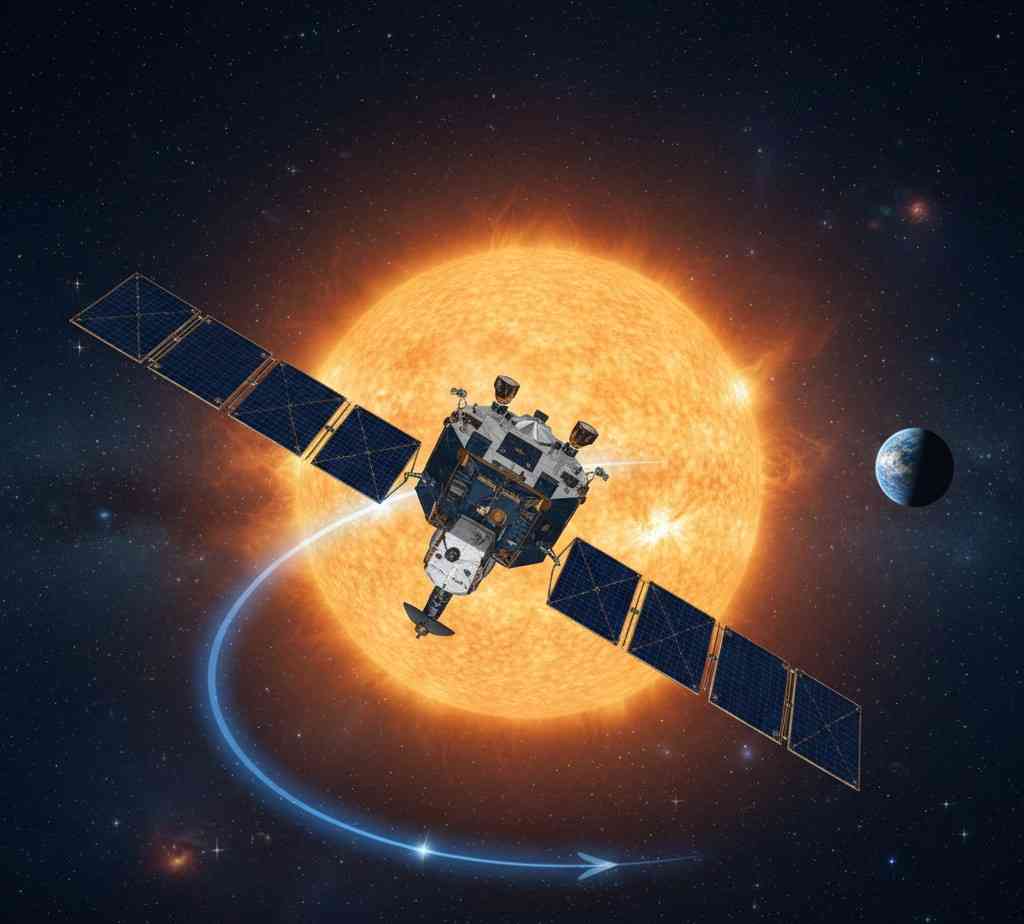
Think of Aditya-L1 like a lighthouse pointed the other way—watching the Sun so Earth isn’t surprised. Solar eruptions and storms don’t just paint auroras; they can disrupt satellites, navigation signals, and power grids. That’s why Aditya-L1 is built to observe the Sun’s outer layers and the space environment that ultimately shapes “space weather.” ISRO
ISRO’s own mission note explains that Aditya-L1’s payload suite is aimed at core solar physics questions—coronal heating, coronal mass ejections, flare behaviour, space weather dynamics, and how particles and fields propagate. ISROSeparately, ISRO’s mission update on halo-orbit operations describes a mission lifetime of five years—important because it tells you the baseline: the “primary innings” is already long. ISRO
So where does “extended mission” come in?
In space missions, “extended mission” usually means: you’ve met primary targets, the spacecraft is healthy, and you choose to keep collecting high-value data—sometimes with sharper goals based on what you learned in the first phase. But as of the public ISRO mission pages cited above, there isn’t a pinned January 2026 announcement that says: ‘extended objectives begin on X date.’ ISRO+1
What an extended mission could plausibly focus on (without pretending it’s confirmed)
- Longer-baseline tracking of solar cycles and recurring active regions
- Better forecasting models for geomagnetic storms (built from richer datasets)
- Refining how we interpret flare/CME precursors—because prediction is where science becomes infrastructure
What it means for you
If you rely on GPS, UPI timing on telecom networks, satellite TV, flight routes, or just a smartphone that quietly depends on space-based systems—solar monitoring is not “science content.” It’s risk management. Aditya-L1 is India building its own upstream visibility.
How to spot real updates
ISRO’s official mission pages and press notes are the cleanest signal. When “extended mission objectives” become real policy, you’ll typically see: a formal statement of revised objectives, operational changes, and sometimes updated collaboration or data-release notes.