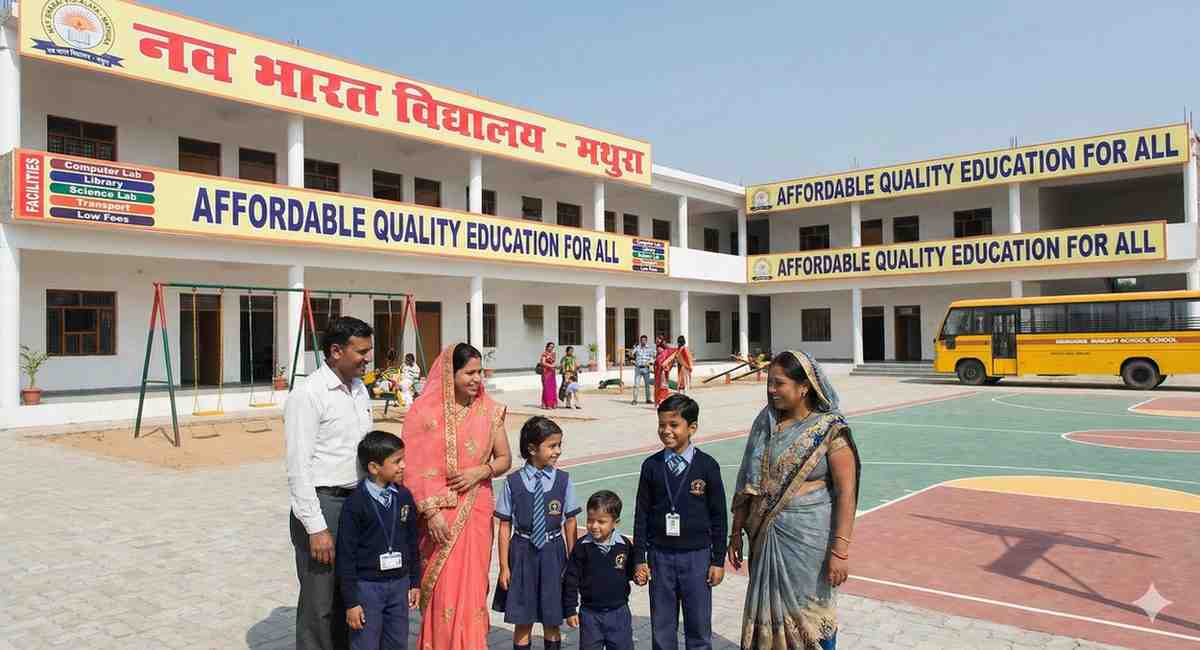
How New Schools in Mathura Are Attracting Families with Affordable Facilities
- admin
- December 5, 2025
- Education, Uttar Pradesh
- 0 Comments
Are Premium Schools Losing Ground to Budget-Friendly Innovators?
Mathura, 2025 — The city of Mathura, a place steeped in heritage and culture, is now seeing a remarkable shift in its educational preferences. Families, once drawn to premium schools with hefty fees, are turning to new institutions that offer modern facilities without breaking the bank. Schools like Vrindavan Scholars Academy, Mathura International Public School, and Shri Krishna Global Institute are reshaping perceptions by providing quality education and state-of-the-art infrastructure at a fraction of the cost, disrupting the long-held dominance of elite institutions.
Redefining “Affordable” with Modern Infrastructure
At schools like Vrindavan Scholars Academy, affordability does not mean a compromise on quality. Spacious, air-conditioned classrooms, smartboards, and well-equipped laboratories reflect facilities once exclusive to high-fee institutions. By employing cost-effective innovations such as solar-powered campuses and digital resource-sharing platforms, these schools cut operational costs without sacrificing educational standards.
Mr. Anil Verma, Director of Mathura International Public School, explains, “Families want value for their hard-earned money. Why should quality education be out of reach for middle-income families? Modern facilities are a right, not a privilege.”
Balancing Value with Quality
While premium schools often charge exorbitant fees for brand value, new schools like Shri Krishna Global Institutefocus on tangible deliverables — modern libraries, playgrounds, and extracurricular opportunities — at affordable prices. Offering a mix of CBSE curricula and skill-development programs, these schools are bridging the gap between traditional academics and 21st-century learning needs.
Parents who previously felt priced out of premier schools now have access to digital literacy programs, STEM labs, and sports facilities at institutions where tuition fees are transparent and significantly lower.
Community-Centric Learning
What sets these schools apart is their focus on community integration and student inclusivity. Mathura International Public School, for example, encourages a community-driven approach through scholarship programs for underprivileged students, free transportation initiatives, and affordable meal plans. This model is reshaping the concept of “elite education” as something that serves all sections of society.
By fostering values of equality and inclusivity, these schools are attracting families eager for quality education grounded in community ethics rather than exclusivity.
Breaking the Premium Illusion
For decades, high fees were equated with superior education, a perception now challenged by schools like Vrindavan Scholars Academy. Parents are beginning to ask tough questions: “Why pay triple for facilities that are now accessible elsewhere at a better price?” The rise of these budget-friendly institutions is compelling legacy schools to re-evaluate their pricing strategies and educational models.
Mrs. Seema Sharma, a parent who recently enrolled her son in Shri Krishna Global Institute, sums it up: “We don’t need frills and fancy names. These schools deliver results, modern facilities, and affordability — it’s a win-win.”
Conclusion
Mathura’s new schools, including Vrindavan Scholars Academy, Mathura International Public School, and Shri Krishna Global Institute, are breaking barriers by offering premium-like infrastructure at family-friendly costs. Their success signals a shift in mindset among parents who now prioritize real value over brand labels.
As these schools continue to disrupt the market, the question for long-established institutions looms large: Will they adapt to this new era of affordable excellence, or risk fading into irrelevance?