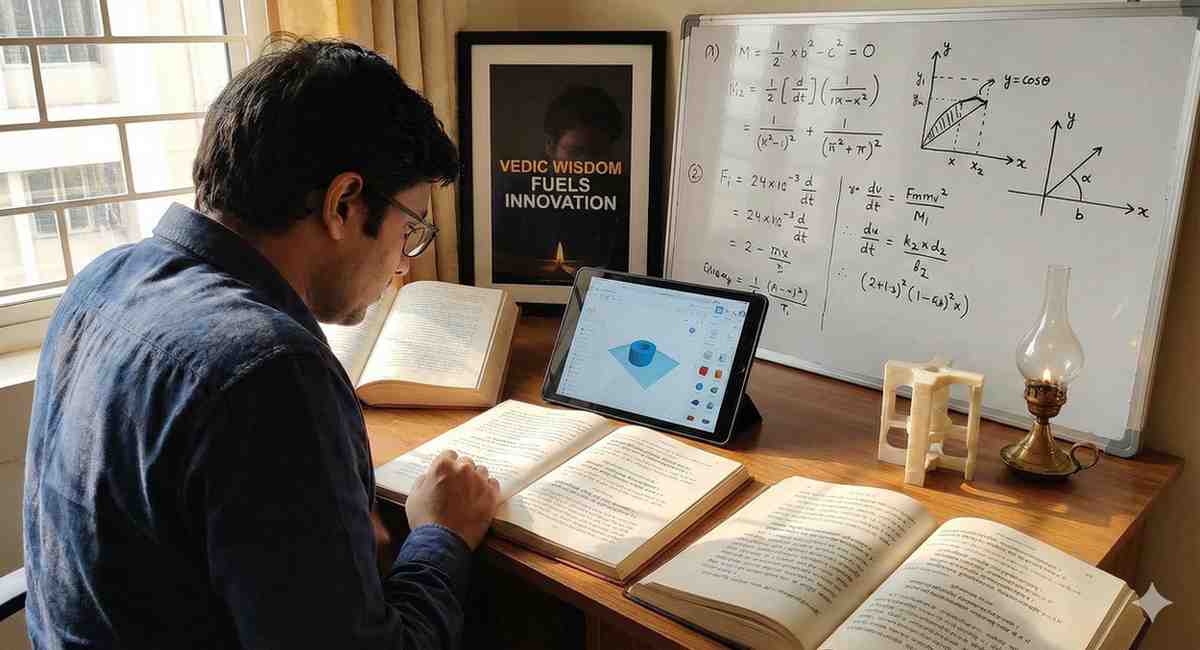
How Do Vedic Teachings Inspire Creativity and Innovation?
- admin
- December 21, 2025
- Psychology, World View
- 0 Comments
“Ancient Wisdom Fueling Modern Ideas: The Creative Spark of Vedic Teachings”
The Vedas, ancient texts revered as the foundation of Hindu philosophy, are not just spiritual or ritualistic guides—they are profound reservoirs of knowledge and insight. They encompass a worldview that fosters inquiry, exploration, and creativity, making them a source of inspiration even in the modern context of innovation. Their teachings encourage individuals to transcend limitations, think expansively, and seek harmony between the material and the metaphysical, offering a timeless framework for creative thinking and innovation.
Creativity Rooted in Universal Principles
- Interconnectedness and Holistic Thinking:
- Vedic philosophy emphasizes the interconnectedness of all existence, reflected in the concept of Rita(cosmic order). This worldview encourages holistic thinking—seeing patterns and connections beyond the obvious, which is a hallmark of creativity.
- Innovators today can draw from this principle, fostering interdisciplinary approaches and systems thinking to solve complex challenges, whether in science, technology, or art.
- Self-Realization and Exploration:
- The Upanishads, extensions of the Vedas, emphasize self-inquiry and the pursuit of inner truth (Atman). This process of introspection nurtures originality and authentic expression, essential for creative endeavors.
- In the arts, such as literature, music, and painting, the emphasis on inner discovery has inspired countless works that explore universal themes of existence, self, and the cosmos.
Practical Paths to Innovation Through Vedic Practices
- Meditation and Clarity of Mind:
- Practices like meditation and dhyana, rooted in Vedic teachings, foster a calm and focused mind, essential for creative problem-solving. Research from institutions like the Harvard Medical School has shown that meditation enhances cognitive flexibility and out-of-the-box thinking, aligning with the Vedic approach to mindfulness.
- Mantras and the Power of Sound:
- The Vedas recognize the vibrational quality of sound and its role in creation and innovation. The rhythmic chanting of mantras not only aids concentration but also sparks inspiration by connecting the practitioner with deeper levels of consciousness.
- Curiosity and Inquiry:
- The Rigveda’s Nasadiya Sukta (Hymn of Creation) embodies an inquiry-driven mindset, questioning the origins of the universe and acknowledging the unknown. This openness to uncertainty and the pursuit of knowledge mirrors the spirit of scientific exploration and technological innovation.
Timeless Inspirations for Modern Innovators
- Sustainability and Innovation:
- The Vedas emphasize harmony with nature, inspiring sustainable innovations in fields like architecture, agriculture, and energy. Practices such as biomimicry draw directly from this ethos, modeling technological advances on natural systems.
- Diversity in Thought:
- The Rigvedic principle “Ekam Sat Vipra Bahudha Vadanti” (Truth is one, the wise call it by many names) celebrates diverse perspectives, fostering an environment where multiple ideas and approaches can coexist and thrive—an essential mindset for innovation.
Conclusion
Vedic teachings offer more than ancient spiritual wisdom; they provide a dynamic and transformative approach to creativity and innovation. By encouraging introspection, interconnected thinking, and the exploration of the unknown, the Vedas empower individuals to transcend limitations and create solutions that resonate with both the human spirit and the universal order.
In a world seeking groundbreaking ideas and sustainable progress, the Vedic tradition serves as an enduring source of inspiration, bridging the timeless with the contemporary.