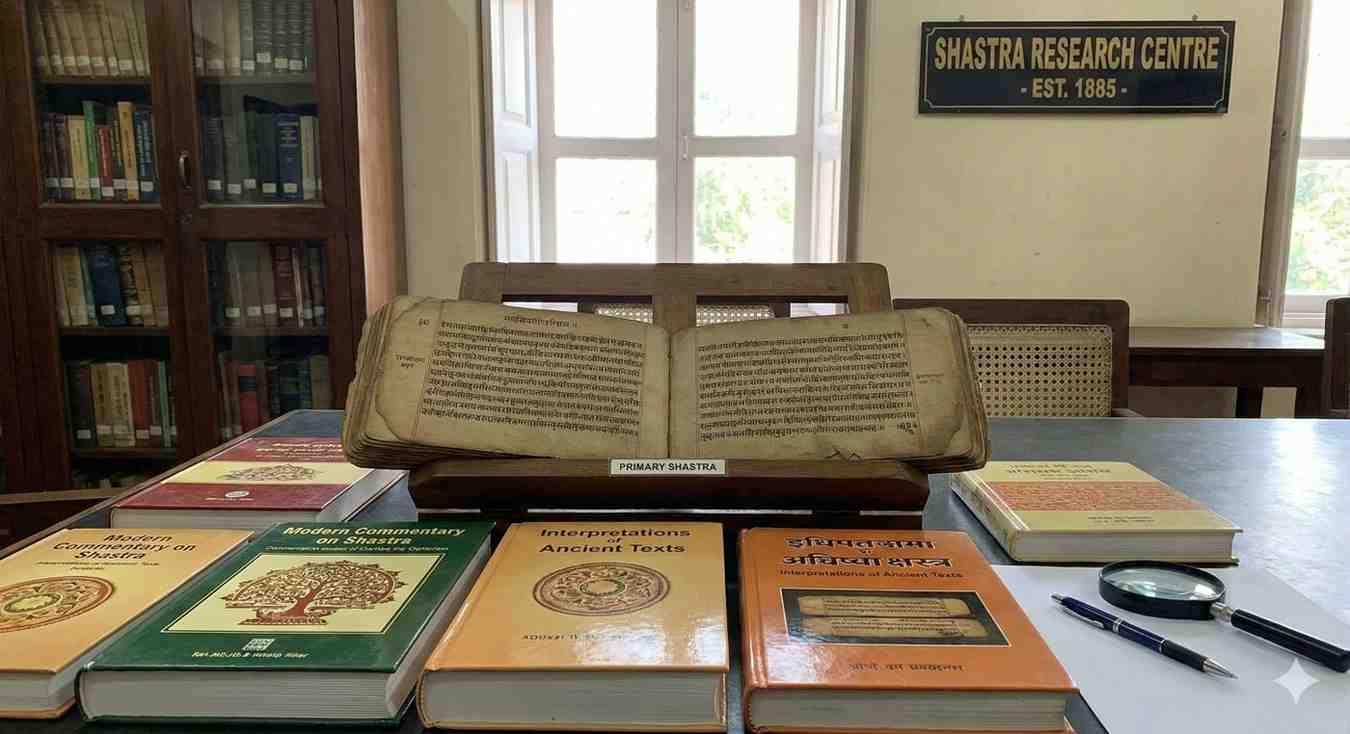
Are Shastras Just Commentaries or Foundational Texts?
“Deciphering the Layers: Shastras as Commentaries or Core Scriptures in Hindu Philosophy”
The Shastras hold a pivotal role in Hindu philosophy, but their classification often sparks debate: Are they merely commentaries on the sacred Vedas, or do they stand as foundational texts in their own right? This discussion delves into the nature of the Shastras, exploring their origins, content, and the profound impact they have on Hindu religious and cultural practices.
Understanding the Shastras
The term Shastra, derived from the Sanskrit root śās, meaning “to instruct,” encompasses a broad category of Indian literature that articulates norms and ideas across various fields including ethics, law, politics, astrology, architecture, and spirituality.
Categories of Shastras:
- Dharma Shastras: Texts like the Manusmriti and Yajnavalkya Smriti that outline moral codes and societal laws.
- Arthashastra: Treatises on politics and economics, the most famous being Kautilya’s Arthashastra.
- Grihya Sutras and Shulba Sutras: Guidelines on domestic rituals and geometrical principles used in altar constructions, respectively.
- Yoga Shastras: Philosophical and practical aspects of Yoga, including Patanjali’s Yoga Sutras.
Shastras as Commentaries
Many scholars view the Shastras primarily as commentaries due to their interpretative nature and their relationship to the Vedas. They often elaborate on Vedic principles, aiming to adapt ancient doctrines to the practical and evolving needs of society.
- Expository Nature:
- The Shastras explain and elaborate on Vedic concepts, making them accessible and applicable to daily life.
- For instance, while the Vedas discuss the theoretical aspects of dharma, the Dharma Shastras provide detailed jurisprudential and ethical guidelines.
- Contextual Adaptations:
- They reflect the societal norms and legal practices of their times, suggesting that Shastras are dynamic and responsive to social changes, unlike the eternal and unchanging Vedas.
Shastras as Foundational Texts
Conversely, the Shastras also serve as foundational texts, establishing new doctrines and philosophical insights that go beyond mere commentary.
- Independent Philosophical Ideas:
- Texts like the Yoga Sutras and Vedanta Sutras introduce and systematize philosophical thoughts that are foundational to schools of Hindu philosophy such as Yoga and Vedanta.
- The Arthashastra presents a detailed manual of statecraft and economics that is unparalleled in Vedic literature.
- Legal and Social Frameworks:
- The Dharma Shastras, such as the Manusmriti, have historically served as the basis for Hindu law and governance, influencing social structures and legal frameworks across centuries.
Impact and Modern Relevance
The Shastras continue to influence modern Hindu thought and practice. They provide a critical link between the abstract spiritual teachings of the Vedas and the practical aspects of living those teachings in diverse societal contexts.
- Cultural and Educational Impact:
- Shastras influence rituals, social conduct, and legal principles, embedding themselves into the cultural fabric of Hindu society.
- Modern institutions and legal systems in India still reflect influences from the Shastras, especially in areas of personal law.
- Philosophical and Spiritual Influence:
- Beyond their role as commentaries, the philosophical Shastras shape the spiritual landscape of Hinduism, offering structured paths to enlightenment and ethical living.
Conclusion
The Shastras are both commentaries and foundational texts, serving dual roles in Hindu philosophy. As commentaries, they interpret and apply Vedic teachings; as foundational texts, they expand on those teachings and create new doctrinal frameworks. This dual nature underscores the Shastras’ significance, making them indispensable to understanding the breadth and depth of Hindu thought and practice. Whether viewed as commentaries or core scriptures, the Shastras remain central to the spiritual and intellectual life of Hindu society, bridging ancient wisdom with contemporary needs.