Is Uttar Pradesh’s New Education Policy Truly Inclusive?
- admin
- December 21, 2025
- Education, Policy, Uttar Pradesh
- 0 Comments
Bridging Gaps or Widening Divides in Education?
Uttar Pradesh, India’s most populous state, is implementing a new education policy aligned with the National Education Policy (NEP) 2020. The reforms aim to transform the education landscape by focusing on foundational literacy, equitable access, and modern pedagogical practices. With the state’s education system catering to over 5 crore students, the initiatives undertaken are ambitious. However, as these reforms unfold, questions remain about their inclusivity and impact on marginalized communities.
Key Highlights of Uttar Pradesh’s New Education Policy
1. Focus on Foundational Literacy and Numeracy (FLN)
- Uttar Pradesh’s efforts are driven by the Nipun Bharat Mission, targeting foundational learning by Grade 3.
- Initiatives: Under the guidance of the Basic Shiksha Adhikari (BSA), districts are working to ensure better reading and arithmetic skills among students, particularly in government schools.
2. Modernization of School Curriculum
- The state is revamping its curriculum to align with NEP 2020’s emphasis on experiential learning, multi-disciplinary approaches, and skill development.
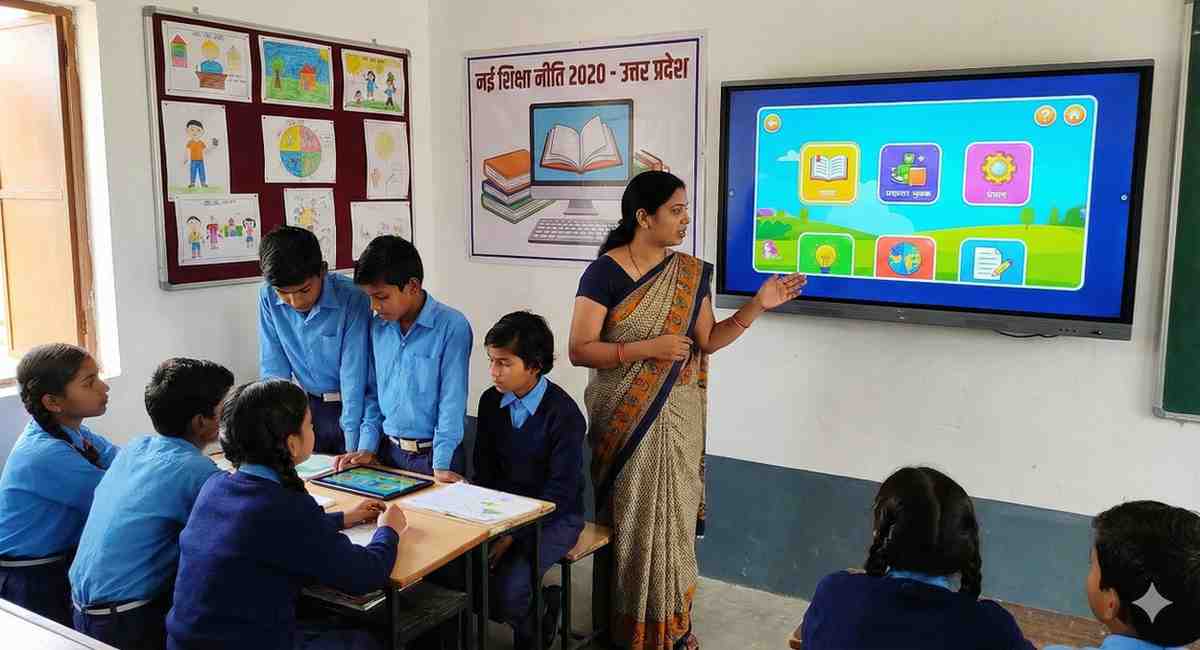
- Digital Education: Smart classrooms are being introduced in 15,000+ schools, and students are being provided with tablets and e-learning resources to enhance digital literacy.
3. Early Childhood Care and Education (ECCE)
- The government is integrating anganwadis with primary schools to ensure seamless early childhood education.
- Key Metric: Over 25,000 anganwadi workers have received training to implement pre-primary learning modules.
4. Vocational Training and Skill Development
- Samagra Shiksha Abhiyan promotes skill-based learning by introducing vocational training from Grade 6 onwards, focusing on job-oriented skills like coding, carpentry, and electronics.
5. Promoting Regional Languages
- In line with NEP, Uttar Pradesh schools are emphasizing teaching in mother tongues such as Hindi and Urdu during early education.
- Policy Change: Teaching materials are being translated into regional languages to promote inclusivity and better comprehension.
6. Digital Inclusion
- The Digi Shiksha Mission aims to address the urban-rural digital divide by providing affordable tablets and laptops to students in rural areas.
- Key Statistic: Over 2 lakh tablets have been distributed in the past year to students in government schools.
Role of Basic Shiksha Adhikari (BSA)
The Basic Shiksha Adhikari plays a pivotal role in implementing and monitoring the state’s education policy at the district level.
- Responsibilities: The BSA oversees teacher training, monitors school performance, and ensures effective implementation of schemes like Nipun Bharat and Operation Kayakalp (infrastructure improvement).
- Key Achievements: In districts like Varanasi and Kanpur, the BSAs have facilitated the construction of sanitation facilities and digital learning centers in government schools, directly impacting learning outcomes.
Is the Policy Truly Inclusive?
1. Bridging Urban-Rural Divides
- Progress: The policy’s focus on foundational literacy, digital education, and anganwadi integration is showing signs of bridging gaps in rural areas.
- Challenge: While urban schools are advancing with digital tools, many rural schools still lack reliable internet and power, limiting the effectiveness of digital initiatives.
2. Support for Marginalized Communities
- Inclusion Efforts: Programs like Kasturba Gandhi Balika Vidyalayas are aimed at improving girls’ education, especially from SC/ST and OBC communities.
- Challenges: Despite these efforts, data from the Unified District Information System for Education (UDISE+)reveals that dropout rates among girls in rural areas remain above 15%, primarily due to socio-economic barriers.
3. Teacher Training and Staffing
- Progress: Over 1 lakh teachers have been trained under the new curriculum guidelines in the last two years.
- Challenges: The pupil-teacher ratio (PTR) in many districts remains below the recommended 1:30, with rural areas facing acute shortages of qualified teachers.
4. Focus on Regional Languages
- While promoting mother tongues is a commendable step, schools in minority-dominated regions report delays in receiving updated teaching materials in Urdu and other regional languages.
- Key Issue: Teachers in these regions require specialized training to handle multi-lingual classrooms effectively.
5. Infrastructure Gaps
- Operation Kayakalp, which aims to improve school infrastructure, has made progress by upgrading 40,000+ schools with functional toilets and clean drinking water.
- Challenges: Over 20% of schools still lack basic amenities like electricity and boundary walls, particularly in Bundelkhand and Eastern UP.
Metrics to Measure Progress
1. Enrolment and Retention Rates
- Net Enrolment Ratio (NER) in primary schools has increased to 98%, reflecting the success of enrolment drives.
- Dropout Concerns: Retention rates remain a concern in secondary education, with an average 20% dropout rate among rural girls.
2. Digital Accessibility
- Tablet Distribution: Over 2 lakh tablets have been distributed under the Digi Shiksha Mission, but connectivity remains a challenge in remote districts.
3. Learning Outcomes
- According to the Annual Status of Education Report (ASER 2022), literacy levels among students in Class 5 have improved by 12% in the last three years, indicating progress under the Nipun Bharat Mission.
Recommendations for Greater Inclusivity
1. Strengthening Rural Infrastructure
- Recommendation: Expand Operation Kayakalp’s reach to ensure 100% of schools have access to electricity, functional toilets, and boundary walls, especially in backward regions like Bundelkhand.
2. Expanding Teacher Training
- Recommendation: Provide additional incentives to attract and retain teachers in rural areas, addressing the pupil-teacher ratio disparity.
3. Enhancing Digital Access
- Recommendation: Invest in reliable internet connectivity for rural schools, ensuring the full potential of digital learning tools is realized.
4. Focus on Dropout Prevention
- Recommendation: Increase financial support for schemes like Kanya Sumangala Yojana, which provide incentives for girls to continue their education.
5. Regional Language Implementation
- Recommendation: Accelerate the production of learning materials in regional languages and provide training for teachers to manage multi-lingual classrooms.
Conclusion: Inclusion in Progress
Uttar Pradesh’s new education policy has brought about significant improvements in foundational literacy, digital education, and infrastructure development. However, the inclusivity of these reforms remains uneven, with rural and marginalized communities still facing barriers to equal access.
The success of these initiatives will depend on addressing gaps in infrastructure, teacher training, and digital accessibility. The state’s focus on foundational learning and skill-based education is a step in the right direction, but sustained efforts will be required to ensure that the benefits of these reforms reach every corner of Uttar Pradesh, leaving no child behind.